Doğu Türkistan Haberleri – Son Dakika – Uygur Haber Ajansı Doğu Türkistan Haberleri ve Çin haberleri; toplama kampları, istihbarat savaşları, İnterpol suiistimalleri, sınır ötesi Uygur avı ve küresel PSC tehdidi analizleri.

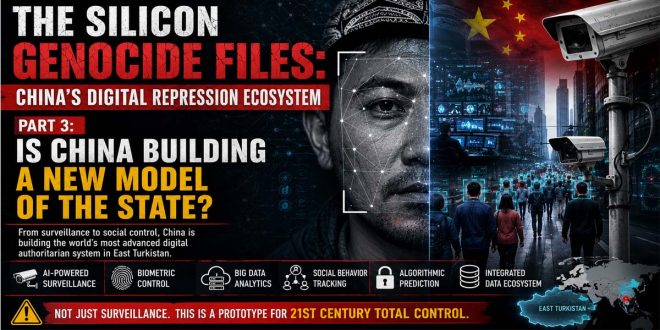
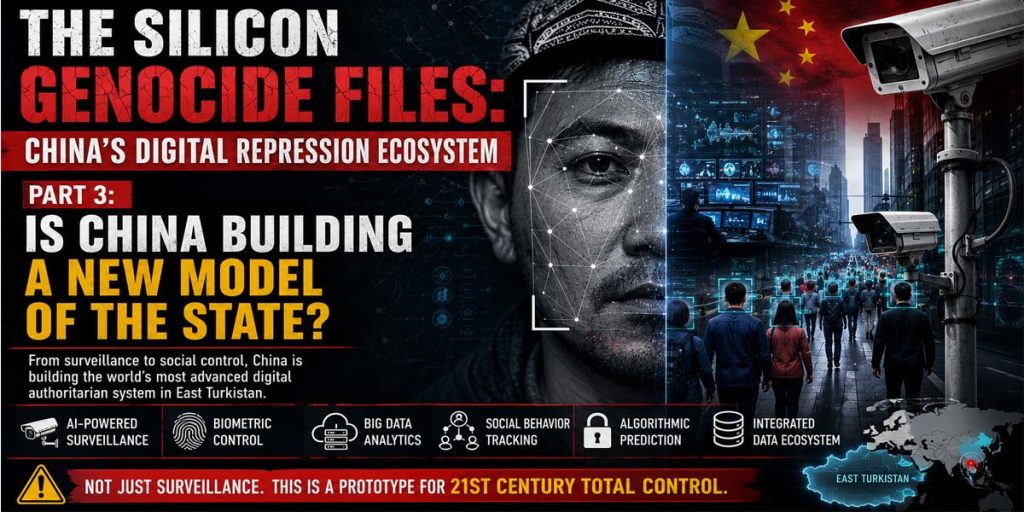
The international community and mainstream media have long focused solely on the physical dimension of the atrocities in East Turkestan. Concentration camps, high walls, barbed wire, and police checkpoints blanketing the streets were, of course, the most tangible manifestations of this brutality. Yet, behind the curtain, the most seamless, systematic, and terrifying form of governance human history has ever witnessed is quietly rising. China is not merely holding East Turkestan under wraps through military methods; it is using the region as the first laboratory of a global technological dystopia to build a new model of the 21st-century state.
The “Hardwired Repression” report, published by the global security and data analytics organization C4ADS, lays bare the logistical and technological blueprint of this next-generation state model. Viewed in the light of this report, the picture is clear: the Beijing administration has breached the boundaries of traditional totalitarian regimes to develop an algorithmic dictatorship prototype that threatens the future of humanity.
1. From the Limited Tools of the 20th Century to the Digital Ecosystem of the 21st Century
Looking back, even the most ruthless authoritarian states throughout the 20th century possessed highly limited, primitive, and cumbersome tools to track their citizens. During that era, states relied on these conventional mechanisms to maintain social control:
- Population records stored in bureaucratic institutions,
- Physical identity cards that citizens were forced to carry,
- Yellowed, dusty police files in law enforcement archives.
However, the control mechanisms of that century suffered from a massive structural vulnerability: these systems were completely fragmented. Intelligence held by one state agency rarely integrated with data held by another; data flow was hostage to sluggish bureaucracy and physical paperwork. Even when states collected large amounts of data on their citizens, they lacked the technological capacity to process, correlate, and analyze this data in real time. Outlining the profile of a dissident or a targeted community took months, sometimes years.
In the 21st century, a chilling model pioneered by China has completely eliminated this vulnerability. Driven by advancing cyber infrastructure, Big Data, and artificial intelligence, states can now aggregate an individual’s:
- Entire movements on the streets and in public spaces,
- All financial purchases, both digital and cash,
- Communications across phone, social media, and messaging networks,
- All domestic and international travel,
- Every social relationship, from whom they have tea with to their family ties,
- Internet activities, including every single link clicked,
- And inevitably, their biometric data, consisting of voice, DNA, iris, and facial scans,
all within a single, centralized system.
Data pools that were once entirely independent and disconnected are now merging into a single, integrated digital ecosystem. C4ADS’s “Hardwired Repression” report documents exactly how such an inescapable, unified structure has been built and flawlessly executed in East Turkestan. Due to this massive algorithmic siege, many scholars and human rights researchers define this next-generation form of governance developed by China as “Digital Authoritarianism.”
2. From Cameras to Algorithms: Moving Beyond Surveillance
From the outside, the surveillance system in East Turkestan might appear to consist merely of a dense network of cameras. The elements first witnessed by visiting journalists or foreign delegations are the facial recognition systems lining the avenues, armored police checkpoints at every intersection, and biometric registration terminals that have become mechanisms of control.
Yet, this is only the tip of the iceberg. The true devastating power and intelligence capability of the system stem from unifying and making sense of the data flowing from these physical tools within a single artificial intelligence hub. Thanks to this integrated system, a targeted Uyghur Turk’s:
- Residential location and the daily routes they utilize,
- Which mosque they attend or their level of religious observance,
- Whom they meet with physically or digitally throughout the day,
- Which mobile applications they use or delete on their phone,
- When and by what means they travel,
- Information regarding which relatives or close associates are abroad,
are consolidated into the very same massive data pool without leaving a single gap.
At this juncture, the Beijing administration has completely discarded the classical understanding of policing. While traditional systems operate on the logic of “intervention after a crime is committed,” this digital ecosystem has shifted to a logic of “intervention before risk materializes.” AI algorithms analyze these millions of data points to predict future individual behavior and social movements. The system perceives even the slightest deviation from a routine (such as a person changing their daily route or turning off their phone for a few hours) as an “anomaly and a threat,” declaring that individual guilty before they even commit an offense—or before it even crosses their mind.
3. The Predictive State Model
The billions of dollars China has heavily invested in East Turkestan’s data centers and cyber infrastructure in recent years do not merely serve the purpose of advanced image recognition or passive data storage. The core strategic objective is to create AI-driven decision-support mechanisms capable of establishing hidden correlations among millions of data points that the human mind cannot grasp, measuring societal fault lines, and predetermining potential risks.
Due to this radical shift, international security strategists and researchers refer to the model implemented in East Turkestan as the “Predictive State.” In this model, algorithms are not passive libraries archiving the past; rather, they act as active judges generating definitive predictions about the future.
Who is deemed “risky” and sent to a concentration camp, whose home will be raided by police, who will be monitored more closely, and which ethnic or social groups will be categorized as a “potential threat” is now largely determined automatically by these data analytics systems rather than human discretion. Human life and liberty have been surrendered to algorithmic scores assigned by artificial intelligence.
4. What Does Digital Authoritarianism Mean Technologically?
The concept of “Digital Authoritarianism,” which is steadily gaining traction in academic literature, refers to the boundless expansion of state power and repressive apparatuses through digital technologies. The technological chasm between classical and digital authoritarianism, alongside the newly acquired capabilities of the state, can be broken down as follows:
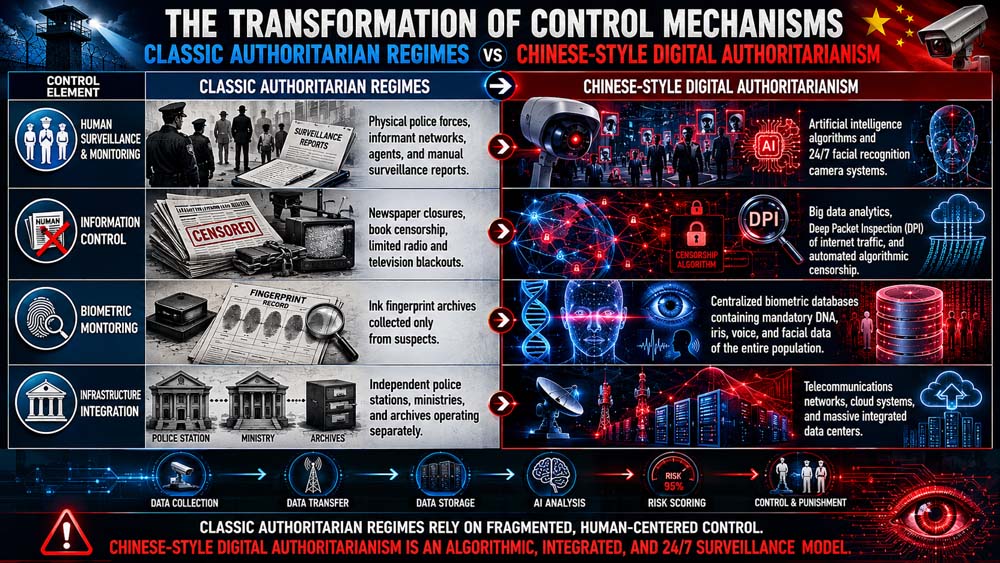
Consequently, the state scales beyond human limitations, achieving an absolute technical capacity to measure, store, and analyze nearly every cell, movement, and even inclination of society.
5. Is East Turkestan a Security Prototype?
Human rights organizations, cybersecurity experts, and academics have long underscored a critical reality: the brutality deployed in East Turkestan cannot be read merely as a local or regional counter-separatist/security policy. For Beijing, this region is the grand test bed and live laboratory for the digital governance models it plans to implement nationwide and globally in the future.
This continuity is plainly visible when examining the history of Chinese repression. In the past, certain harsh security policies and profiling methods tested in Tibet were optimized and transferred to East Turkestan. Similarly, the AI surveillance technologies, software, and data center architectures developed, tested, and perfected using the data of millions of oppressed people in East Turkestan are now expanding to China’s other provinces and megacities (such as Beijing, Shanghai, and Shenzhen). This definitively proves that East Turkestan is not just a security operation zone for China, but a “prototype area” for testing next-generation state technologies prior to mass production.
Conclusion: A Question Posed to the Future of Humanity
The system engineered and continuously deepened in East Turkestan is fundamentally not about “installing more cameras” or “building larger data centers.” The true, overriding danger is that a totalitarian state has successfully unified every single crumb of information collected about a citizen—regardless of civil or military distinctions—into a single digital ecosystem.
The mechanism runs like a flawless clockwork: cameras harvest raw data. State-controlled telecom firms seamlessly transmit these communication logs and internet traffic. Hyperscale data centers store and classify this colossal information. Ultimately, artificial intelligence systems analyze all this data to shackle individuals and society alike. The resulting output is a digital governance model of a scale and technological depth never before seen in human history, eclipsing both Nazi Germany and Soviet Russia.
Therefore, the real issue that demands global debate today is not merely the presence of cameras on the streets of East Turkestan. The true global question confronting us is this:
Is China constructing the 21st century’s first full-scale, inescapable “digital authoritarian state model”? And how prepared is the world to face it?
Editor’s Note: The Anatomy of an AI-Driven Algorithmic Siege
While the international community has long focused on the physical dimensions of the oppression on the ground, a much more dangerous infrastructure of mass control is quietly rising behind the scenes. In this striking third part of THE SILICON GENOCIDE FILES, we push past the visible barbed wire and camera networks to target the invisible technological brain of the system. East Turkestan has been transformed into a global testing ground for a massive mass surveillance system—one that is heavily fed by global tech supply chains. The c4ads security watch reports, particularly the groundbreaking “Hardwired Repression” data, lay bare the logistical and mathematical codes of this human hunt.
The evidence from the hardwired repression report proves that street cameras are merely data-harvesting extensions; the real devastating power lies within the central servers processing this information. Our editorial analysis reveals that the state has successfully established a unprecedented integrated data ecosystem, allowing the regime to analyze a citizen’s life within seconds. Pervasive cyber intelligence networks embedded into public buildings and communication lines track everything from physical movements to daily purchases. This entire apparatus is continuously fed by a comprehensive biometric data pool that fuses facial recognition, voice prints, and DNA profiles into a single repository.
The Beijing administration manages this entire society through sophisticated AI algorithmic control mechanisms, using the region as a living laboratory. Newly deployed predictive policing algorithms can flag the slightest deviation from a daily routine as an anomaly, branding individuals as threats before a crime is ever committed. This radical shift explains why the concept of Chinese digital authoritarianism has become one of the most heavily debated topics in global academic and security circles.
What we face in East Turkestan today is not just a localized security policy; it is a dangerous digital dictatorship prototype ready to be exported across borders. This highly optimized East Turkestan surveillance tech completely strips the individual of privacy while granting the state absolute power.
Our editorial team remains committed to deciphering the algorithmic darkness behind these human rights violations. We leave you with this in-depth analysis of the predictive state model—a digital dystopia that, if left unchecked today, will inevitably threaten the global future of human democracy tomorrow.
In Part 4 of THE SILICON GENOCIDE FILES, we will examine how this perilous digital authoritarianism model, perfected in the East Turkestan laboratory, is being exported beyond China’s borders as a “governance product” to countries across Central Asia, Africa, and the Belt and Road routes, and how it hems in global democracy.