 Doğu Türkistan Haberleri – Son Dakika – Uygur Haber Ajansı Doğu Türkistan Haberleri ve Çin haberleri; toplama kampları, istihbarat savaşları, İnterpol suiistimalleri, sınır ötesi Uygur avı ve küresel PSC tehdidi analizleri.

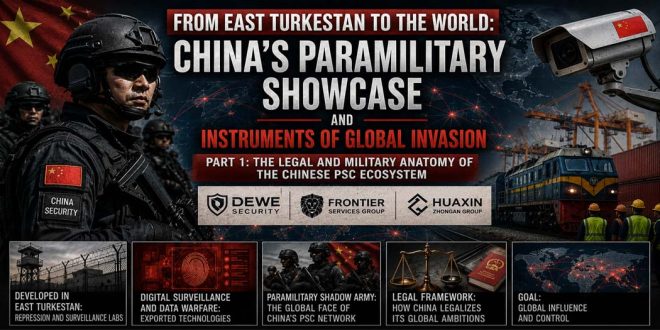
For many years, global public opinion debated Private Military and Security Companies (PMSCs) such as Russia’s Wagner Group, which sowed brutality across active conflict zones, or the US-based Academi (formerly Blackwater), which turned Iraq and Afghanistan into a bloodbath. However, the Beijing administration meticulously analyzed the corruption scandals of Western companies and the brute force blunders of Russia, launching a model into the global security market that is stealthier, deeper, and far more dangerous than them all.
In order to protect its global invasion movement carried out under the Belt and Road Initiative (BRI), China has built a brand-new paramilitary shadow army, marketed to the world as “commercial and ordinary private security firms.” Occupied East Turkestan served as the primary laboratory for Beijing’s global hegemony apparatus and digital fascism mechanism. All suppression and surveillance methods developed in East Turkestan to oppress, monitor, incarcerate in concentration camps, and enslave Uyghur Turks are today being exported to the world as front instruments of invasion through these so-called “private” companies.
So, are these structures—which protect billion-dollar port, railway, and mining projects globally, such as Beijing DeWe Security, Frontier Services Group (FSG), and Huaxin ZhongAn Group—truly “private”? In this first part of our expose, we lay bare the legal camouflage Beijing hides behind to bypass international law, alongside its official military-intelligence links and evidence.
1- Deciphering the Legal Camouflage: The 51% Mandatory State Ownership
The claim that Chinese Private Security Companies (PSCs) are purely commercial, profit-driven entities like their Western counterparts is Beijing’s greatest global lie. When examining Chinese domestic legislation and legal regulations, it is as clear as day that these companies are not independent commercial actors, but rather direct and official extensions of the state and the Chinese Communist Party (CCP).
The 2009 Regulation and State Monopoly: The Regulation on the Administration of Security and Guarding Services, enacted by the State Council of China, forms the backbone of Chinese security firms. According to this law, all Chinese PSCs conducting strategic operations abroad are mandated to have at least 51% of their shares owned directly by the Chinese state or state-owned enterprises (SOEs).
Direct Ministerial Supervision: The licensing, auditing, and operational approval processes of these companies are executed by the Chinese Ministry of Public Security (MPS). In other words, the financial and operational control of a company that reads “private” on paper is 100% in the hands of the state.
2- CCP Commissars on Corporate Boards: The Mechanism of “Absolute Loyalty”
Russia’s Prigozhin crisis with the Wagner Group and the fiasco of soldiers mutinying against the state were analyzed down to the smallest detail by Beijing. Because China does not want a mercenary model that could slip out of state control or operate based purely on financial gain, it has placed its iron fist at the very heart of these companies: Party Commissars.
Pursuant to China’s Company Law and the CCP charter, it is mandatory to establish “Party Cells” within the board of directors and administrative staff of every security firm expanding abroad. Sitting right next to the companies’ general managers or operational chiefs, these CCP commissars monitor that all decisions comply with the party’s ideological and strategic interests. Field personnel are made to swear an oath of “Absolute Loyalty” to the CCP and President Xi Jinping even before signing commercial contracts. Through this mechanism, although these companies appear to be commercial enterprises, they are actually bound directly to the command-and-control chain of the CCP Central Committee.
3- The Chain of Command: A Core Rooted in the People’s Liberation Army (PLA) and Intelligence (MSS)
When the biographies of the co-founders, chief executive officers, and field commanders of Chinese PSCs are examined, the picture that emerges resembles a general staff headquarters rather than a private security company.
The Military and Intelligence Network: Without exception, the management cadres of these companies consist of former officers and intelligence personnel rooted in the People’s Liberation Army (PLA), the Chinese Military Police, or the Ministry of State Security (MSS).
Strategic Staffing: For example, Frontier Services Group (FSG), owned by the Chinese state investment giant CITIC Group, or DeWe Security, which manages thousands of personnel in Africa, place former elite officers with counter-terrorism and intelligence backgrounds directly at the helm of their operational field teams.
This situation constitutes the most dangerous link in Chinese military doctrine: To avoid international backlash and not be labeled an “occupier,” the Chinese military (PLA) deploys these former officers—who have taken off their uniforms but retain their loyalty and chain of command intact—under the guise of “security guards” to fragile geographies where it cannot send its regular troops.
4- The Legal Legitimacy Cloak of a Global Threat: The 2015 National Security Law
The Beijing administration has made it a legal obligation for these shadow armies to carry out aggressive expansionism globally and engage in any intelligence or operational activities when necessary. The Chinese National Security Law, adopted in 2015, is the ultimate legal armor behind this threat.
The law does not limit the concept of “national security” strictly to Chinese territory; it encompasses all of China’s economic, political, digital, and overseas interests across the globe. Although the text does not name them explicitly, it obligates all overseas-operating institutions and private entities—namely PSCs—to protect the national security interests of the Chinese state and work in full coordination with its intelligence agencies. Reinforced by the 2015 Counter-Terrorism Law and the 2021 Anti-Foreign Sanctions Law, this legal infrastructure imposes espionage, data collection, and field manipulation upon Chinese security companies as a statutory command on behalf of the state’s interests in the countries they deploy to.
EXECUTIVE SUMMARY: THE NEW TOOL OF BEIJING’S EXPANSIONISM
The global security architecture is facing an unprecedented transformation as Beijing deploys its private instruments of expansion worldwide. Moving beyond traditional defense strategies, Chinese PSCs have evolved into tactical tools that secure critical infrastructure while projecting power along the Belt and Road Initiative (BRI). This is not merely a commercial effort; it represents a highly organized Paramilitary Shadow Army directly linked to Beijing’s state apparatus. Tested and weaponized first through digital fascism in occupied East Turkestan, these surveillance and containment models are now being exported globally.
By strategically embedding political overseers within corporate boards, the CCP Central Committee guarantees total control over these entities, eliminating any risk of independent mutiny. This structural alignment allows Beijing to easily wage Gray-Zone Warfare, executing intelligence operations without triggering international backlash. Backed by the legal framework of China’s National Security Law, multi-billion-dollar entities like the Frontier Services Group (FSG) operate as enforcement wings of state intent rather than typical business ventures. Ultimately, this Hybrid Warfare Model combines economic dominance with paramilitary force, establishing a new Global Hegemony Apparatus that rewrites the rules of international security and strategic competition.
Doğu Türkistan Bülteni Haber Ajansı / HABER MERKEZİ
REFERENCES :
1- Legal Camouflage, 51% State Ownership and MPS Audit
State Council of the People’s Republic of China (2009 Official Regulation): 《保安服务管理条例》 (Regulation on the Administration of Security and Guarding Services). Founding legislation enacted by the Chinese Council, legally mandating that at least 51% of the shares of all Private Security Companies (PSCs) operating in strategic areas must belong directly to the state or State-Owned Enterprises (SOEs) and be audited by the Ministry of Public Security (MPS).
ICoCA (International Code of Conduct Association – Geneva): “China’s Private Security Sector and the State-Owned Enterprise Model”. Corporate review report revealing that Chinese PSCs, unlike their Western counterparts, operate not commercially but as legal extensions of the CCP with a 51% state share requirement.
2- CCP Cells on Boards of Directors and the Company Law
Company Law of the People’s Republic of China – Article 19: The constitutional article making it a legal obligation to establish Chinese Communist Party (CCP) cells (Party Cells) within company boundaries, to budget these structures, and to ideologically supervise corporate boards of directors according to the directives of the CCP Central Committee.
MERICS (Mercator Institute for China Studies): “Guardians of the Belt and Road: Party Control and Ideological Loyalty in China’s Non-State Security Sector”. Strategic dossier analyzing the CCP’s “Absolute Loyalty” mechanism in overseas security companies and the veto powers of party commissars on boards of directors following Russia’s Wagner/Prigozhin crisis.
3- Command Cadre, Structural Links Originated from PLA and MSS
Frontier Services Group (FSG) Corporate Governance and Financial Reports: Corporate registration records containing the weight of the Chinese state’s giant investment group, CITIC Group, in the company’s ownership structure, and the official biographies of former People’s Liberation Army (PLA) and intelligence (MSS) elite officers at the head of management cadres and counter-terrorism units.
SIPRI (Stockholm International Peace Research Institute): “The Growth of Chinese Private Security Companies along the New Silk Road”. Military report decrypting the doctrine of infiltrating risky geographies, where the Chinese military (PLA) cannot set foot in official uniform, under the “PSC mask” through former officers and paramilitary cadres.
USCC (U.S.-China Economic and Security Review Commission): “China’s Global Security Architecture: The Role of Military Veterans and State Security Personnel in PSCs”. Official senate report listing the military and intelligence origins of the founders and executives of Chinese PSCs.
4- Legal Armor of the Global Threat: 2015 National Security and Counter-Terrorism Laws
National Surveillance and Security Legislation of the People’s Republic of China (2015): 《中华人民共和国国家安全法》 (National Security Law). The umbrella law that expands China’s national security interests to cover cyber, economic, and overseas investments across all world geographies, and forces all foreign subsidiaries (including PSCs) to share intelligence with the state.
Counter-Terrorism Law of the People’s Republic of China (2015) and Anti-Foreign Sanctions Law (2021): Legislative articles imposing a legal order on Chinese security companies to conduct cyber-physical operations, gather intelligence, and manipulate the field in the countries they visit in line with CCP interests.
HASTAG : #EastTurkestan #Uyghur #China #ChineseSecurity #PSC #PrivateSecurity #InvestigativeReport #GlobalSecurity #Geopolitics #HumanRights #SurveillanceState #CCP #PLA #ChinaWatch #BeltAndRoad #BRI #SecurityStudies #InternationalAffairs #AsiaPacific #DigitalAuthoritarianism #Intelligence #MilitaryAnalysis #GlobalInfluence #StrategicStudies #WorldPolitics #ChinaResearch #Authoritarianism #SecurityNetwork #PoliticalAnalysis #InvestigativeJournalism
#BreakingNews #WorldNews #GlobalNews #InternationalNews #Geopolitics #China #EastTurkestan #Uyghur #HumanRights #InvestigativeJournalism #GlobalSecurity #SecurityStudies #PoliticalAnalysis #ChinaWatch #WorldPolitics #InternationalAffairs #DigitalSurveillance #SurveillanceState #CCP #PLA #MilitaryAnalysis #StrategicStudies #GlobalInfluence #BeltAndRoad #BRI #AsiaPacific #Intelligence #Authoritarianism #PrivateSecurity #ChineseSecurity


