 Doğu Türkistan Haberleri – Son Dakika – Uygur Haber Ajansı Doğu Türkistan Haberleri ve Çin haberleri; toplama kampları, istihbarat savaşları, İnterpol suiistimalleri, sınır ötesi Uygur avı ve küresel PSC tehdidi analizleri.


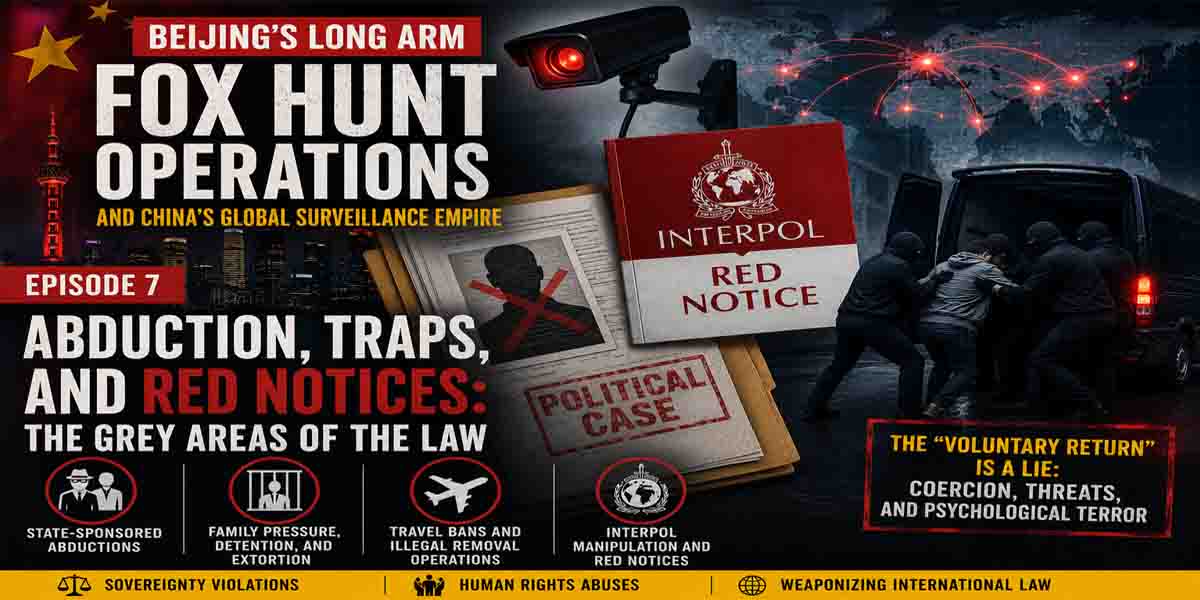
The “Fox Hunt” and “Sky Net” operations conducted by the People’s Republic of China (PRC) on a global scale have evolved far beyond judicial processes targeting economic fugitives. The Beijing administration systematically manipulates international legal mechanisms, bypasses the jurisdiction of sovereign states, and exploits legal gray areas to commit severe human rights violations. In this dossier, we examine the illegal methods utilized by the Chinese intelligence and security apparatus in the international arena, its manipulation of Interpol, and its blatant violations of national sovereignty.
1. Structural Abuse of the Interpol System and Asymmetric Surge
One of the most strategic pillars of China’s global surveillance strategy is its attempt to transform the International Criminal Police Organization (Interpol) into an international extension of its domestic political purges, dissident suppression, and transnational repression mechanisms. Under normal circumstances, Red Notices are legitimate judicial tools designed to locate, provisionally arrest, and apprehend fugitives for extradition. However, Beijing weaponizes them as “digital handcuffs” and systematic psychological coercion tools to restrict the movement of targeted individuals.
According to data from Safeguard Defenders, the number of Red Notices and “Blue Notices” (issued for information-gathering) requested by China via Interpol has seen a dramatic and asymmetric surge over the past decade. The ascension of Xi Jinping to power in 2012, followed by the launch of his sweeping “Anti-Corruption” campaigns, provided the legal camouflage for these global manhunts. China exploits the core data-sharing mechanisms of Interpol, which rely heavily on principles of mutual trust and urgency among member states. Capitalizing on the fact that the General Secretariat lacks the budget and personnel to deeply vet tens of thousands of notice requests each year, Beijing continuously pumps groundless or highly politicized criminal files into the centralized database.
Legal Camouflage: Economic Crime Packaging and Article 3 Violations
Article 3 of the Interpol Constitution strictly forbids the organization from undertaking “any intervention or activities of a political, military, religious or racial character.” This rule was designed precisely to prevent the international police body from becoming an enforcement tool for authoritarian regimes. However, the Chinese legal bureaucracy has developed a sophisticated camouflage method to bypass this global barrier. Targeted political activists, human rights defenders, bureaucrats ousted in internal power struggles, or representatives of ethnic minorities (particularly Uyghurs and Tibetans) are never introduced into the system via their political identities. Instead, they are packaged under ordinary and purely economic criminal charges such as “abuse of office,” “tax evasion,” “bribery,” “money laundering,” or “embezzlement of corporate funds.” Consequently, the Interpol secretariat fails to detect the underlying political nature of the file at first glance and approves the notice.
Defamation and the Mechanism of Psychological Terror
A vast majority of the allegations behind these notices are fabricated specifically to defame targeted individuals within their host Western societies and the broader international community. The moment a Red Notice is issued against a dissident, Chinese state media activates its propaganda apparatus, presenting the notice to both domestic and international audiences as absolute “proof of guilt.” Even if the targeted individual is legally capable of defending themselves within their country of asylum, they are dragged into a state of total psychological paralysis, living under the continuous, looming fear of surveillance, sudden detention, and deportation to China.
Multi-Layered Strategic Threats
Beijing’s manipulation of the Interpol system triggers a chain of destructive, multi-layered consequences for its targets:
-
Deprivation of Freedom of Movement: An individual subject to a Red Notice is automatically detained at border checkpoints or airports the moment they step out of their host nation into a third country. This creates a physical blockade, effectively preventing dissidents from traveling to international bodies (such as the UN or European Parliament) to speak out against China’s human rights abuses.
-
Financial Siege: International banking and risk analysis systems (such as World-Check) sync Interpol Red Notice lists directly into their databases. As a result, individuals blacklisted by Beijing face frozen bank accounts, are blocked from establishing businesses, and are left financially isolated, making basic survival in their host countries nearly impossible.
-
Collapse of Judicial Trust: These predatory practices poison multilateral judicial cooperation mechanisms. The law enforcement agencies of democratic nations are merged into the same operational pot as the controlled judiciary of an autocratic regime, weaponizing international law through the very organization tasked with preventing international crime.
2. Inside the Shadows: State-Sponsored Abductions and the Myth of “Voluntary Return”
The darkest and most flagrant violations of international law within the hierarchy of Beijing’s tactics involve direct kidnappings, extortion, and unlawful repatriation operations aimed at returning targeted dissidents, activists, and individuals deemed hazardous to the regime. Chinese official sources and state media habitually claim that individuals returning through these operations do so “voluntarily, expressing remorse, and choosing to return to face justice” (persuasion to return). However, concrete evidence brought to light by international human rights organizations and intelligence reports reveals that there is absolutely no consent at any stage of this process. Instead, the entire operation relies on coercion, threats, psychological terror, and unlawful extraterritorial intelligence operations.
The Beijing administration operates this illegal mechanism—which completely bypasses the judicial processes of sovereign states—through a deeply entrenched, three-tiered architecture of entrapment and coercion:
A. Hostage Politics and Extortion via Family (Collective Punishment)
The Chinese security apparatus is well aware that the fastest way to bring an overseas target to their knees is to utilize the loved ones they left behind on Chinese soil as leverage. This phase is executed under the doctrine of collective punishment and includes the following tactics:
-
Economic and Social Siege: Family members, relatives, and even distant acquaintances living in China are systematically fired from their jobs, stripped of social security benefits, and have their bank accounts frozen. This is deliberately engineered to send a clear message to the target abroad: “Your family is being condemned to starvation because of you.”
-
Judicial Coercion and Arbitrary Detention: If the target continues to refuse to return, parents, spouses, siblings, or children are detained under fabricated pretexts or sent to concentration camps and prisons.
-
Forced Confessions and Digital Torture: Chinese police place detained family members in front of cameras, forcing them to record scripted videos pleading with their overseas relatives: “Confess your crimes, trust our state, come back, and save us from this misery.” These videos are sent directly to the target via encrypted messaging applications, inflicting an unbearable weight of guilt and psychological devastation.
B. Extraterritorial Shadow Agents and Physical-Digital Tracking (Illegal Operations Teams)
Special operations teams deployed by Chinese intelligence and the Ministry of Public Security (MPS) infiltrate democratic nations where the rule of law prevails (such as the US, Canada, the UK, or EU countries). These agents enter host countries disguised as tourists, academic researchers, businesspeople, corporate representatives, or under official diplomatic cover.
-
Physical and Close Surveillance: Agents physically stalk the target’s home, workplace, and their children’s school routes. They snap photographs and leave these images at the target’s doorstep or send them to their digital accounts, delivering a chilling message: “We are watching your every move; you are never safe.”
-
Direct Threats and Confrontations: In several instances, Chinese agents have directly knocked on targets’ doors or left extortion letters behind reading, “Return to China or commit suicide.” Recent indictments and sting operations led by the FBI against “Fox Hunt” teams on US soil have exposed just how brazenly these shadow agents operate within Western metropolitan areas.
C. Direct Physical Detention and Extraterritorial Abductions (Extraordinary Rendition)
In nations where legal loopholes exist, judicial safeguards are weak, or where governments maintain tight political, military, and economic dependencies on Beijing (such as through the Belt and Road Initiative), China completely skips extortion and persuasion. It deploys direct physical force to execute kidnappings.
-
Corruption and Manipulation of Local Security Forces: Through bribery or political leverage, Chinese agents co-opt corrupt local security elements or domestic intelligence units in the target country. Targets are snatched in broad daylight from the streets, their homes, or workplaces by individuals wearing local police vests or masked Chinese agents.
-
Lawless Transit Lines: Abducted individuals are held without ever seeing a judge, completely stripping them of their right to seek asylum. They are detained within Chinese consular buildings possessing diplomatic immunity or in clandestine safe houses. From there, they are repatriated directly to the PRC via specially arranged charter flights, vehicles with diplomatic cargo status, or illegal maritime routes. Mysterious disappearances in Thailand, Cambodia, the United Arab Emirates, and even certain Eastern European nations—where targets vanish only to reappear weeks later handcuffed on Chinese state television delivering forced confessions—stand as the most concrete testaments to this state-sponsored piracy.
Through this multi-layered, tyrannical mechanism, Beijing does not merely capture its specific target; it delivers a chilling, global ultimatum to all regime dissidents worldwide: “If you oppose us, we will hunt you down at the ends of the earth, destroy your loved ones, and drag you back.”
3. Third-Country Operations: Morphing Political Might into Judicial Coercion
The PRC is fully aware that executing direct, physical kidnappings within advanced Western democracies where the rule of law and democratic institutions are robust carries an exceptionally high diplomatic and political price. A flagrant abduction in such countries triggers severe international crises, espionage trials, and inflicts heavy blows to Beijing’s global image. To bypass this strategic hurdle, Chinese intelligence services and the Ministry of Public Security have engineered a highly sophisticated doctrine of “geographical relocation and entrapment.” The objective is to lure protected, legally secure targets out of their safe havens in the West and draw them into “third countries” where Beijing’s political, military, and economic leverage is absolute.
Sophisticated Baiting Strategies
Beijing’s operational units analyze the vulnerabilities, financial situations, family ties, and professional ambitions of targeted individuals through months of digital and physical surveillance. Based on these insights, flawless, customized camouflage operations are set in motion:
-
Lucrative Job Offers and Academic Invitations: The target is approached with high-budget consultancy projects, prestigious speaking slots at international conferences, or executive positions at multinational firms located outside the West. All correspondence is handled through shell companies with corporate identities or co-opted intermediaries to project total legitimacy.
-
Inheritance and Legal Traps: Targets are notified that they have been left a massive inheritance by a relative in China or an adjacent region. They are told that to finalize the legal proceedings, they must personally travel to a specific law firm located in a third-country free-trade zone.
-
Staged Family Emergencies and Health Crises: Family members inside China are coerced into contacting the target, begging them to travel to a neighboring border state (such as Thailand or Laos) where they can meet without entering China. Heavy emotional manipulation, such as “Your mother is on her deathbed and wants to say her final goodbyes here,” is used to paralyze the target’s rational decision-making.
Global Hunting Grounds and Spheres of Influence
The “third countries” into which targets are lured are never chosen at random. These topographies comprise regions where China has injected massive capital through the Belt and Road Initiative, trapped local governments via debt-trap diplomacy, or territories ruled directly by authoritarian regimes:
-
Southeast Asia (Thailand, Cambodia, Laos): This region serves as the primary “gray hunting ground” for China’s transnational operations. The local security bureaucracy and immigration departments frequently execute directives originating directly from Beijing.
-
Central Asia and the Middle East (Kyrgyzstan, Tajikistan, UAE): These locations function as strategic operational bases where China has signed bilateral security and anti-terror pacts, allowing it to trigger deportation mechanisms completely bypassing judicial review.
Extralegal Deletions and Lawless Delivery
The moment the target falls into the trap, leaves their protected Western haven, and steps foot into the third country, the most critical phase of the operation begins. The local Chinese embassy and intelligence teams on standby immediately activate domestic security forces. Utilizing secret bilateral security agreements or economic extortion, they ensure the host country’s local authorities detain the target.
During this phase, the host country entirely disregards international asylum law and the core principle of non-refoulement. The target is barred from appearing before a court, denied access to legal counsel, and blocked from contacting the United Nations High Commissioner for Refugees (UNHCR). Local administrative bodies swiftly issue bogus administrative deportation orders citing “visa violations” or “threats to national security.” The individual is then escorted through airport backdoors or secret hangars, loaded onto planes sent explicitly from China, and handed over in handcuffs directly to Chinese security forces.
Gui Minhai and Symbolic Precedents
The most internationally resonant example of this ruthless strategy is the case of Swedish citizen and book publisher Gui Minhai. Believing he was safe in Europe while publishing works critical of the Chinese regime, Minhai mysteriously vanished from his vacation home in Thailand in 2015. Weeks later, without any legal extradition process having taken place, he appeared handcuffed on Chinese state television (CCTV) delivering a forced confession. Minhai’s case demonstrated to the world that possessing a Western passport provides no absolute shield against China’s third-country traps. Human rights activists abducted from Thailand, Uyghur asylum seekers quietly packaged and shipped from Cambodia, and dissident businessmen deported from Dubai to China stand as tragic evidence of how political power is transformed into a global empire of judicial coercion.
4. Legal Loopholes and the Exploitation of Extradition Treaties
The PRC professionally and systematically exploits structural flaws within global legal systems to circumvent international law norms and bilateral judicial cooperation mechanisms. A majority of democratic states, particularly European Union member nations, steadfastly refuse to sign official Extradition Treaties with Beijing. This refusal is rooted in the fact that the Chinese judicial system operates under the absolute control of the Communist Party, lacks fair trial guarantees, presents a systematic risk of torture, and actively utilizes the death penalty. The principle of non-refoulement—the cornerstone of international law prohibiting the return of individuals to places where they face torture or death—remains the greatest legal barrier preventing democratic courts from approving extraditions to China. Yet, Beijing’s legal bureaucracy and intelligence apparatus bypass this seemingly insurmountable barrier through parallel, deceptive methods that neutralize international protection mechanisms from behind.
Targeting Gray Processes and Transient Legal Statuses
Chinese security elements understand they cannot file formal legal extradition lawsuits against individuals who have secured definitive refugee status or citizenship in their host nations. Therefore, the operational crosshairs are trained on individuals living in a bureaucratic limbo, holding transient legal statuses:
-
Asylum Seekers in Process: Individuals who have requested international protection but whose applications are pending—often languishing in immigration courts for years—are prime targets.
-
Temporary Residency and Visa Holders: Individuals holding student visas, temporary work permits, or humanitarian residency permits who are approaching status renewal periods are meticulously tracked during these windows of vulnerability.
Beijing treats these critical “gray phases,” where individuals lack a comprehensive legal shield under host-country laws, as windows of operational opportunity.
Bypassing the Judiciary: Manipulating Immigration Authorities
To seize their targets, Chinese diplomatic missions (embassies and consulates-general) bypass independent, transparent “Judicial Courts.” Instead, they execute infiltration operations through the “Shadow Army”: Immigration Authorities and Border Management Agencies, which are far more susceptible to executive decisions and administrative manipulation.
The local Chinese embassy feeds host-country immigration ministries or administrative deportation units highly manipulated, falsified dossiers designed to frame the target as a “hardened criminal threatening national security.” These files typically feature charges like terrorism financing, organized trafficking, or international fraud—headings engineered to trigger “red alarms” within Western immigration offices. The explicit goal is to prevent the matter from being viewed as a “political asylum” case, reducing it to a routine administrative deportation process based on public safety threats.
Administrative Deportation Traps Devoid of Judicial Oversight
The most dangerous dimension of this strategy is that many administrative processes run by immigration authorities lack the high standards of transparency, comprehensive evidence vetting, and extensive defense rights inherent to criminal courts. Operating behind closed doors or via accelerated bureaucratic procedures, these administrative pathways form one of the largest legal black holes, enabling China to capture individuals without ever needing a formal extradition treaty.
When immigration officers fail to recognize the political motivations underlying Chinese-supplied documentation, or when these processes are overshadowed by commercial and diplomatic ties between the two nations, administrative deportation orders or transfers to removal centers can be issued instantly. Before the individual ever gets the chance to stand before an independent judge and prove the risk of torture awaiting them in China, they are deported via administrative decree into China’s transnational net. Beijing successfully transforms the West’s own legal bureaucracy and immigration codes into a guillotine used against the very oppressed individuals the West promised to protect.
5. Sovereignty Violations and the Globalization of Transnational Repression
The most severe and threatening dimension of the “Fox Hunt” and “Sky Net” operations regarding global security architecture is the Beijing administration’s blatant, reckless, and systematic violation of the national sovereignty of independent states. The foundational principle of the Westphalian order, upon which international law and the modern state system are built, dictates that a state possesses absolute and exclusive jurisdiction over its own territory. Deploying clandestine intelligence operations, embedding operational execution/surveillance teams, and attempting to forcibly enforce domestic laws on foreign soil without the explicit consent, permission, and cooperation of the host state constitutes an absolute trampling of the international law principles of “sovereign equality and non-interference.” Through these brazen steps, Beijing asserts a unilateral extraterritorial jurisdiction globally, attempting to position foreign nations as mere local branch offices of its own Ministry of Public Security.
Institutionalized Lawlessness: Unlawful Chinese Secret Police Stations (110 Overseas)
The most concrete and shocking proof of how China has transformed its national sovereignty violations from isolated incidents into an “institutionalized network” is the global discovery of unlawful “Chinese Secret Police Stations” (110 Overseas). Deşifre edilerek dünya başkentlerinde şok dalgası yaratan bu merkezler, Safeguard Defenders tarafından açığa çıkarılmış olup, Avrupa metropollerinden (Paris, Madrid, Londra) Kuzey Amerika’ya (New York, Toronto) kadar düzinelerce ülkede konuşlandırılmıştır.
-
The Cover of Consular Services: These illegal police stations are marketed to the outside world and the official authorities of host states as “civilian logistical centers helping Chinese citizens with bureaucratic tasks like driver’s license renewals, passport extensions, or official document registrations.”
-
Illegal Operational Bases: However, the reality behind the curtain is entirely different. These centers are illegal intelligence and operational hubs managed directly by the Chinese Ministry of Public Security (MPS) and local Chinese provincial police units (specifically the Fuzhou and Qingtian law enforcement bodies). Operated completely in secret from the law enforcement and intelligence agencies of their host nations, these cells entirely flout local laws and security bureaucracies.
Transnational Repression Functions of the Stations
These clandestine centers act as the boots on the ground for the Chinese regime’s transnational repression policies, conducting the following illegal activities:
-
Coordinating Local Agent Networks: They establish local intelligence networks that log the current addresses, workplaces, and social circles of regime dissidents, asylum seekers, and ethnic minorities living in the respective countries.
-
Threats and “Persuasion” Sessions: Targeted individuals are contacted via telephone or summoned directly to these secret station buildings under the guise of an “interview,” where they are threatened. Here, they are subjected to heavy extortion to return “voluntarily” to China—without any formal extradition process ever being initiated—by reminding them that their families back in China are not safe.
-
De Facto Usurpation of Sovereign Rights: By acting as a parallel judicial and law enforcement power within the sovereign borders of the host state, these centers effectively usurp that nation’s obligation to protect the people living on its soil (suzerainty).
The Global Digital and Physical Surveillance Empire
Through these institutional and illegal networks, Beijing transmits a crystal-clear, arrogant message to the world: “The absolute authority of the Chinese state cannot be constrained by geographical borders or international law rules.” Combining advanced facial recognition technologies, AI-powered cyber-tracking mechanisms, 5G infrastructure infiltrations, and physical secret stations deployed across the globe, the Chinese Communist Party has constructed a hybrid global surveillance empire.
This globalized empire of repression does not merely erode the sovereign rights of democratic states; it breeds a deep climate of fear and insecurity among refugee communities living in Western societies. Recent raids, closures of these secret stations, and expulsions of Chinese agents by nations like the United Kingdom, the United States, and Germany demonstrate just how hot and perilous this sovereignty war has become on the global stage.
Conclusion and Future Danger: The Autocratic Transformation of the Global Legal Order
Kidnappings, systematic extortion executed via family members, sophisticated traps set in third-country ports, and the manipulation of deeply rooted multilateral institutions like Interpol are no longer exceptional anomalies in China’s global tracking operations; they have become ordinary, institutionalized, and budgeted Standard Operating Procedures (SOPs). Professionally analyzing the gray areas of international law, sovereignty vacuums, and bureaucratic inertia, the Beijing administration feeds on the profound silence developed by the international community due to economic dependencies, as well as the loopholes in domestic legal codes.
However, this state of affairs is not merely a localized human rights issue confined to the physical safety of Chinese dissidents or ethnic minorities; it is a structural threat directed squarely at the heart of the rules-based global legal order.
The Looming Dystopia and Multi-Layered Future Dangers
Should Beijing’s reckless transnational repression architecture continue to expand unchecked, it will inevitably yield the following catastrophic consequences on a global scale in the near future:
-
The Total Collapse of the Right to Asylum and Refugee Law: The Geneva Convention and refugee protection systems constructed after the Second World War as a collective achievement of humanity face the danger of becoming entirely obsolete against China’s parallel tactics that manipulate immigration bureaucracies. If democratic states become incapable of protecting asylum seekers within their own borders, the concept of “political asylum” will devolve into a mere piece of paper, and the world will transform into a hunting ground for autocrats.
-
The Emergence of a Malign “Role Model” for Autocratic Regimes: China’s failure to face deterrent punishments in the international arena for its sovereignty violations and extrajudicial operations encourages other authoritarian regimes worldwide (such as Russia, Iran, and Saudi Arabia) to commit similar transnational outrages. Beijing’s “successful” prototype is turning into a global blueprint for all dictatorships seeking to silence their dissidents.
-
The Redefinition of Sovereign Borders by “Might”: The principle of “geographical sovereignty” brought by the Westphalian order is being replaced by the claims of autocratic powers asserting “absolute ownership over citizenship bonds or ethnic origins.” In this scenario, Beijing will continue to arrogate to itself the right to unlawfully penalize anyone, anywhere in the world, who refuses to submit to its authority.
The Global Line of Resistance: Urgent Action and an Uncompromising Legal Barricade
To protect both their national sovereignty and ensure the physical safety and fundamental rights of individuals seeking refuge on their soil, democratic states must urgently erect a collective, multilateral, and uncompromising “legal barricade” and security shield. This protective wall must be built through the following radical steps:
-
Securing International Institutions: Critical structures like Interpol must undergo stringent vetting and transparency reforms to counter the Red Notice manipulations of autocratic regimes. Heavy sanctions, including temporary suspension of membership, must be applied to states attempting to inject politically and ethnically motivated files into the system.
-
Fortifying Immigration Bureaucracies: Immigration departments and border management personnel must be trained to discern the underlying political vengeance behind bogus files presented by China under the guise of “ordinary crime” or “public safety threats”; administrative deportation processes must be subject to mandatory, independent judicial review.
-
Hardening Espionage and Transnational Repression Laws: Host countries must deploy a “zero tolerance” policy against Chinese agents and diplomatic mission personnel operating illegal stations (110 Overseas) or conducting physical and digital surveillance on their territory; these individuals must be directly expelled, refusing to allow them to hide behind commercial or diplomatic relationships.
Otherwise, Pekin’s long arm will continue to reshape the boundaries of global law according to its own dictatorial norms, censorship mechanisms, and oppressive vision. The vulnerability and silence displayed by the democratic world today will open the gates to a world order tomorrow where global justice is entirely plunged into darkness.
East Turkestan Bulletin News Agency / NEWS CENTER
BIBLIOGRAPHY AND FURTHER READINGS
This investigative dossier was compiled by leveraging comprehensive reports from international human rights organizations, official institutional documents, international legal texts, court records, and academic research. Readers who wish to obtain more detailed information on the subject may refer to the following foundational sources:
1. International Human Rights and Research Reports
-
Safeguard Defenders
-
Official Website: https://safeguarddefenders.com
-
Chasing Fox Hunt: A comprehensive investigative report on China’s “Fox Hunt” operations, transnational repression activities, and unlawful repatriation mechanisms.
-
110 Overseas: A detailed report on China-linked illegal police stations operating globally, their operational methods, and sovereignty violations.
-
-
Amnesty International
-
Official Website: https://www.amnesty.org
-
Core Documented Areas: Human rights violations in China, arbitrary detentions, transnational repression, enforced disappearances, and freedom of expression reports.
-
-
Human Rights Watch
-
Official Website: https://www.hrw.org
-
Core Documented Areas: China’s international repression policies, suppression of Uyghurs, Tibet, Hong Kong, and crackdowns targeting dissidents abroad.
-
-
Freedom House
-
Official Website: https://freedomhouse.org
-
Featured Publication: Out of Sight, Not Out of Reach
-
Core Documented Areas: Transnational Repression reports and global analyses on the extraterritorial clampdowns of authoritarian regimes.
-
2. Official International Institutions
-
INTERPOL
-
Official Website: https://www.interpol.int
-
Primary Reviewed Documents: INTERPOL Constitution, Article 3 (Political Neutrality), Red Notice System, Blue Notice System, and Rules on the Processing of Data (RPD).
-
3. United Nations Documents
-
United Nations Human Rights Office (OHCHR)
-
Official Website: https://www.ohchr.org
-
Primary Reviewed Documents: Statements by UN Special Rapporteurs on China, reports from the Working Group on Arbitrary Detention, reports from the Special Rapporteur on Torture, and documentation from the Working Group on Enforced or Involuntary Disappearances.
-
-
UNHCR (The UN Refugee Agency)
-
Official Website: https://www.unhcr.org
-
Primary Reviewed Documents: Refugee Law, the Principle of Non-Refoulement (Non-Deportation to Danger), and Guidelines on International Protection.
-
4. Official Judicial Records
-
Federal Bureau of Investigation (FBI)
-
Official Website: https://www.fbi.gov
-
Primary Reviewed Cases: Investigations into Fox Hunt operations, unlawful operations linked to the Chinese Ministry of Public Security (MPS), and investigations regarding illegal Chinese police stations on US soil.
-
-
U.S. Department of Justice (DOJ)
-
Official Website: https://www.justice.gov
-
Primary Reviewed Cases: Fox Hunt trials, criminal indictments against Chinese state agents, transnational repression, and foreign espionage investigations.
-
5. Academic Research
-
Primary Areas of Academic Inquiries Consulted:
-
Transnational Repression
-
Extraterritorial Policing
-
International Human Rights Law
-
International Criminal Law
-
Refugee Law
-
Forced Repatriation
-
International Extradition Law
-
6. International News and Investigative Journalism Sources
-
The verified investigative dossiers, exclusive reporting, and fact-checked news archives of the following international media outlets were examined within the scope of this research:
-
Reuters
-
Associated Press (AP)
-
BBC
-
Deutsche Welle (DW)
-
The Guardian
-
The New York Times
-
The Washington Post
-
Editorial Note
The information presented in this investigative dossier has been prepared based on a comparative analysis of public official documents, international organizational reports, court records, academic studies, and credible journalistic sources. Contentious or disputed allegations have been conveyed exactly as they appear in their respective sources, adhering strictly to the principles of verifiability, multi-source cross-examination, and editorial neutrality.


