Doğu Türkistan Haberleri – Son Dakika – Uygur Haber Ajansı Doğu Türkistan Haberleri ve Çin haberleri; toplama kampları, istihbarat savaşları, İnterpol suiistimalleri, sınır ötesi Uygur avı ve küresel PSC tehdidi analizleri.

İlgili Makaleler


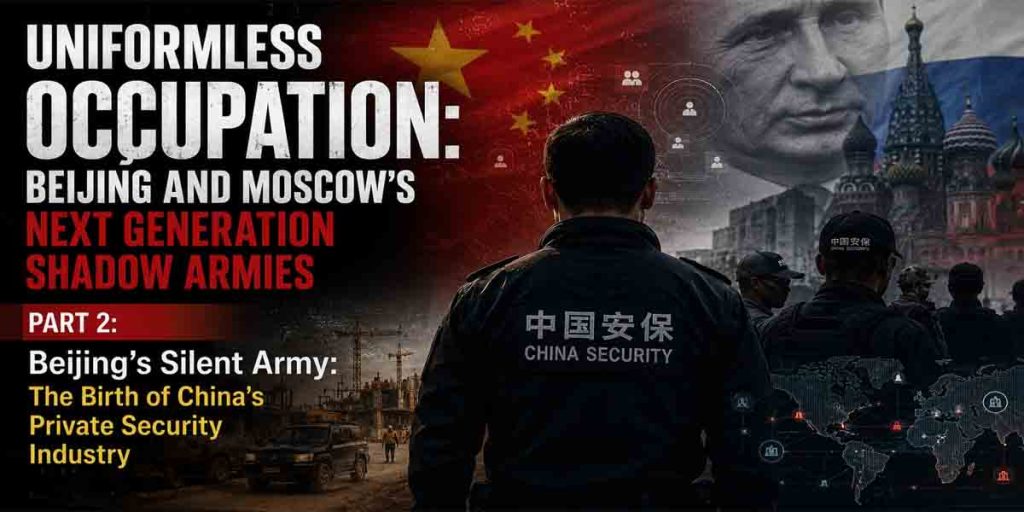
While the world focuses on Russia’s aggressive, loud, and barrel-pointing shadow armies like Wagner or the Africa Corps along lines stretching from Ukraine to the depths of Africa; Beijing is conducting a massive, whisper-quiet “silent occupation” beyond its borders. Instead of deploying its official military, the People’s Liberation Army (PLA), to protect its multi-billion-dollar global investments and millions of citizens, China positions state-driven, hybrid-structured Private Security Companies (PSCs) as geopolitical shields.
However, this is not a classic “mercenary” market as perceived in the West. Beijing weaves a unique, “weaponless but absolutely controlled” global security network by exploiting loopholes in international law and the vulnerabilities of host countries. With a total workforce of 6.4 million personnel—dwarfing regular armies—how do these un-uniformed forces, pulled by the invisible strings of the Ministry of Public Security, turn the gaps in the international system to their advantage by pulling the trigger through locals while the brainpower is blown from Beijing?
In the second part of our “Occupation Without Uniform” series, we dissect the biggest mystery behind the headlines: the birth and operational anatomy of China’s silent army.
I. How Did the Security Sector Emerge in China?
The birth and cross-border expansion of the private security sector in China has progressed through three fundamental stages directly linked to the country’s economic transformation, opening-up strategy, and ideological bottlenecks in foreign policy:
- Evolution in the Domestic Market (1980s-2000s): Following Deng Xiaoping’s reforms, China entered a period of fierce economic growth. As factories, banks, mining sites, and commercial areas grew rapidly, public law enforcement fell short of covering every corner. To protect this boom in property and local businesses, firms providing physical security and watchman services at the local level were permitted for the first time. During this period, the sector was entirely confined within China’s borders and consisted of basic watchkeeping activities.
- The “Belt and Road” Fracture and the Security Vacuum (Post-2013): The real geopolitical leap that transformed the sector into a global actor occurred with the announcement of the “Belt and Road Initiative” (BRI) in 2013. Chinese State-Owned Enterprises (SOEs) ventured into multi-billion-dollar investments to build ports, energy lines, mines, and railways across Africa, Central Asia, the Middle East, and Latin America. This unchecked geographical expansion brought severe crises: the kidnapping of Chinese engineers by terrorist organizations, raids on construction sites, anti-Chinese riots by local populations, and civil wars turned more than a million Chinese citizens on the continent into open targets. Beijing urgently needed a security shield.
- The “Non-Intervention” Paradox and the Strategic Solution: The greatest historical taboo of Chinese foreign policy is the principle of non-interference in the internal affairs of other countries. Sending the Chinese People’s Liberation Army (PLA) into the territories of sovereign states to protect these investments would mean both violating this principle and facing global accusations of being a “neo-colonial/imperialist power.” Beijing devised a ingenious formula to overcome this diplomatic dilemma: According to Chinese domestic law, offensive “Private Military Companies” (PMCs) engaging in active combat would remain strictly illegal; however, the globalization of structures holding “Private Security Company” (PSC) status, focused on defense, surveillance, and logistics, would be cleared. Thus, the state would officially keep its hands clean while protecting its interests via a shadow mechanism.
II. The Role of the Ministry of Public Security (MPS)
In the Chinese model, the word “private” never implies capital independence or free-market dynamics in the Western sense. Companies here are organic extensions of the Chinese Communist Party (CCP) and the state apparatus. At the heart of this absolute control mechanism sits the Ministry of Public Security (MPS), China’s domestic security, intelligence, and law enforcement giant.
Absolute Accreditation and Invisible Strings
For a Chinese security firm to expand overseas, obtain passports for its personnel, and sign international contracts, it depends directly on the approval and absolute audit of the MPS. The Ministry monitors these companies’ financial structures, client portfolios, and overseas business partnerships at all times. Loyalty always precedes commercial profitability.
Cadre Fluidity and CCP Cells
The top executives of these companies are not ordinary business people. Boardrooms and operational managements are packed with former MPS bureaucrats, retired high-ranking generals from the PLA, or intelligence officers from counter-terrorism units. Furthermore, inside every major security team sent abroad, secret or overt party cells (committees) reporting directly to the CCP are established.
Security Diplomacy and Institutional Infiltration
The MPS uses these companies not just to protect commercial areas, but to conduct “security diplomacy” in target countries. In the African or Central Asian nations they enter, Chinese PSCs provide tactical training to local police forces, supply them with Chinese-origin facial recognition and technological surveillance infrastructure, and offer logistical support. Through this, the MPS infiltrates the official law enforcement agencies of the target country via these companies, harvesting direct intelligence networks and establishing leverage over local bureaucracy.
III. 6.4 Million Security Personnel: The World’s Largest Paramilitary Pool
When viewed in terms of manpower and logistical scale, China’s security industry constitutes one of the largest paramilitary reserve zones human history has ever witnessed.
A Number That Dwarfs Armies: Today, more than 6.4 million security personnel are employed within thousands of registered companies operating inside and outside China. To put this in perspective; this number is more than three times the size of the Chinese People’s Liberation Army (approx. 2 million)—the world’s largest active regular military—and more than four times the total personnel size of the US military.
- Demographic and Military Subsidy Mechanism: The Chinese military demobilizes hundreds of thousands of soldiers every year. Having this trained, disciplined, and weapon-savvy population unemployed in civilian life could pose a serious domestic security and social explosion risk for Beijing. This is exactly where PSCs step in as a buffer mechanism. Elite commandos, special forces operators, and logistics specialists leaving the military are directly funneled into these companies.
- Global Operational Reserve: Although the vast majority of these 6.4 million personnel protect critical infrastructure, subways, and government buildings within China, this massive human pool provides Beijing with an endless, instantly mobilizable elite reserve force for overseas operations. Beijing keeps a massive, trained army alive under the guise of the private sector without spending a single penny of additional official defense budget.
IV. Differences Between the Chinese Model and the Western Model
Chinese PSCs are sharply separated from their American (e.g., the former Blackwater/Academi) or British counterparts structurally, philosophically, and operationally. These differences also explain why China’s “silent occupation” strategy draws less backlash than traditional military methods:
EDITOR’S NOTE
In this second installment of our exclusive investigative series, we expose how China is rewriting the rules of global influence not through overt military force, but through the rapid expansion of its state-backed Private Security Companies. While the international community remains fixated on the loud and violent operations of Russia’s Wagner Group, Beijing is quietly executing a Silent Occupation along the critical corridors of the Belt and Road Initiative.
Driven by the strategic directives of the CCP and managed under the strict oversight of the Ministry of Public Security, these entities serve as a sophisticated tool of Hybrid Warfare. By turning hundreds of thousands of demobilized soldiers into a massive Paramilitary pool, Beijing bridges the gap between commercial interests and deep Intelligence gathering. This deep dive unravels the complex Geopolitics and the calculated Defense Policy behind a multi-million-dollar industry that is reshaping global security architecture from the shadows.
REFERENCES
- Fondation pour la Recherche Stratégique (FRS) – Russia and Chinese Private Military and Security Companies in Africa: Two Competing Models? (Djenabou Cissé, Simon Menet, Marie de Vries, 2025)
- SIPRI (Stockholm International Peace Research Institute) – Analyses on private security companies, global armaments, and the relationship between paramilitary structures and states.
- IISS (International Institute for Strategic Studies) – Reports on China’s security policies, Asia-Pacific geopolitics, and non-state security actors.
- CSIS (Center for Strategic and International Studies) – Analyses on the Belt and Road Initiative (BRI), China’s global security strategy, and African operations.
- RAND Corporation – Studies on the military modernization of the People’s Republic of China, the deployment of hybrid forces, and security doctrines.
- Brookings Institution – Research on China’s foreign policy, the Belt and Road strategy, and global networks of influence.
- World Bank Data – Data regarding China’s foreign investments, infrastructure projects in developing countries, and economic expansion.
- United Nations (UN) Reports – Global risk reports and documents on international security, state sovereignty, and private military structures.
- Council on Foreign Relations (CFR) – Analyses on China’s global strategic expansion, African policies, and security diplomacy.