Doğu Türkistan Haberleri – Son Dakika – Uygur Haber Ajansı Doğu Türkistan Haberleri ve Çin haberleri; toplama kampları, istihbarat savaşları, İnterpol suiistimalleri, sınır ötesi Uygur avı ve küresel PSC tehdidi analizleri.

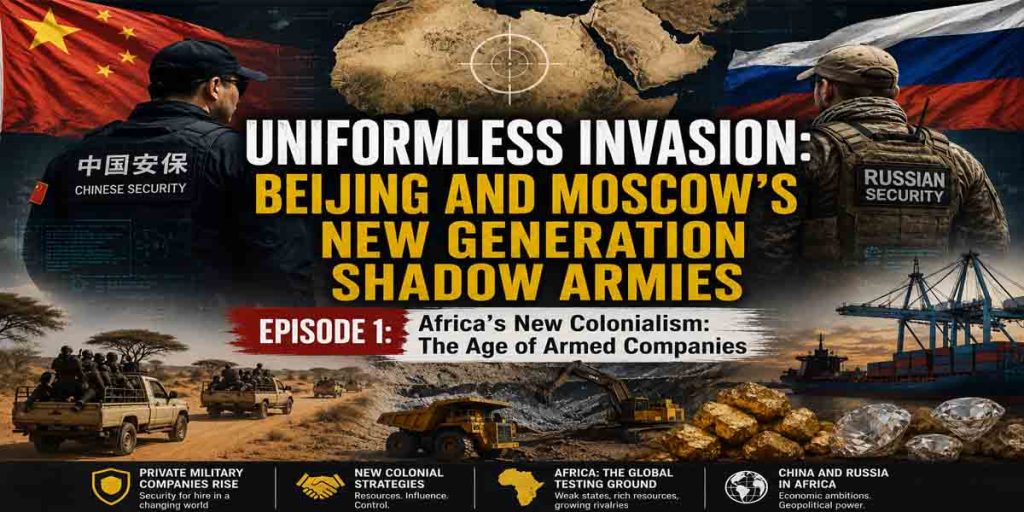
Once, the warships of colonial empires loomed on Africa’s horizons, carrying uniformed soldiers and colonial governors. Today, the landscape has fundamentally shifted. The entities docking at the continent’s ports are no longer traditional armies; they are private security corporations, consulting networks, tech giants, and invisible power hubs. Official uniforms may have faded from the frontlines, but the struggle for hegemony rages fiercer than ever. China and Russia are waging a relentless war for influence stretching from Africa’s strategic mines and energy corridors to its ports and digital infrastructure. On the frontlines of this conflict stand next-generation shadow armies—devoid of state insignias, yet operating as proxies for state interests. The “Occupation Without Uniforms” series aims to unveil the hidden machinery behind these rapidly expanding security empires, the global rise of private military companies, and the covert rivalry between Beijing and Moscow over the continent. Just as witnessed during the occupation of East Turkistan, Africa is now being systematically cornered through a dangerous combination of mercenary forces and cyber-fascism.
WHY ARE PRIVATE MILITARY COMPANIES EXPANDING?
Following the end of the Cold War, states worldwide began downsizing their defense budgets. Yet, global security threats did not vanish. On the contrary, internal conflicts, terrorist networks, piracy, and political instability generated unprecedented security demands.
In this volatile environment, Private Military and Security Companies (PMSCs) experienced exponential growth. Governments and multinational corporations bypassed regular armed forces in favor of private contractors—which offered greater flexibility, faster deployment capabilities, and significantly lower political liability. Consequently, security services transformed into a multi-billion-dollar commercial industry.
Initially restricted to static facility protection, convoy escorting, or basic risk assessment, these firms have gradually assumed far more sophisticated roles. Today, modern private security entities gather intelligence, conduct complex tactical analyses, train foreign police forces, and actively provide combat support in high-intensity conflict zones.
WHY DO STATES PREFER MERCENARY SECURITY FORCES?
For modern nation-states, private security firms provide more than mere cost-efficiency; they offer invaluable political flexibility through plausible deniability.
Deploying a country’s official military to foreign soil triggers stringent international law protocols, diplomatic crises, and severe domestic public backlash. Conversely, by deploying private contractors, states can effectively insulate themselves from direct accountability.
This dynamic grants major global powers a substantial strategic edge. It allows them to project military power and safeguard assets abroad without officially placing boots on the ground. Consequently, governments can robustly enforce their geopolitical agendas while maintaining a calculated, legal distance from the actions perpetrated on the field. This reliance has intensified with the rise of hybrid warfare, where contemporary battles are fought not just with tanks and fighter jets, but through information operations, economic coercion, cyber warfare, and privatized security networks.
WHY AFRICA HAS BECOME A GLOBAL LABORATORY
The African continent presents an ideal environment for the unchecked growth of the private security sector and the testing of modern neo-colonial models.
Institutional fragility across various regions, porous borders, transnational terrorism, ethnic friction, and recurrent coups collectively drive the demand for security. Simultaneously, Africa remains home to some of the world’s richest reserves of strategic natural resources.
Critical materials such as gold, diamonds, cobalt, lithium, copper, uranium, and oil are vital to the future of the global economy. To secure these high-stakes investments, foreign enterprises and sovereign states increasingly deploy private security networks. In many cases, these corporations do not just secure isolated facilities; they assume full operational control over strategic ports, critical railways, energy transit lines, and expansive mining concessions. This merges corporate economic exploitation with armed security operations in unprecedented ways.
THE GEOPOLITICS OF CHINA AND RUSSIA IN AFRICA
In recent years, China and Russia have emerged as the most disruptive and influential actors across the continent, utilizing distinct yet overlapping doctrines:
- China’s Doctrine (Economic Security Enclosure): Beijing’s approach is fundamentally driven by economic geostrategy. Under the umbrella of the Belt and Road Initiative (BRI), China has embedded itself in ports, railway networks, energy grids, and mineral extractions across Africa. Safeguarding these massive investments requires a sophisticated security architecture. As a result, Chinese-headquartered Private Security Companies (PSCs) have expanded aggressively across the continent. Although legally categorized as private commercial entities, their executive boards are heavily staffed by former People’s Liberation Army (PLA) officers, elite police officials, and individuals deeply connected to state intelligence organs. As Beijing’s economic footprint expands, its shadow security grid expands in lockstep.
- Russia’s Doctrine (Political Leverage and Mercenary Power): Moscow’s strategy operates on a different axis, seamlessly blending security services with direct political interference. Through the infrastructure established by the Wagner Group (now rebranded as the Africa Corps) and affiliated proxy networks, Russia offers regime survival packages, elite praetorian guard training, and tactical military support in direct exchange for lucrative mining concessions and geopolitical loyalty.
CONCLUSION
Ultimately, Africa is no longer just a arena for resource competition; it has evolved into a global geopolitical stage where next-generation, un-uniformed security models are actively refined. The transformation unfolding across the continent today mirrors the core mechanics of historical exploitation, even if colonial governors have been replaced by private defense contractors, corporate corporate networks, and covert security grids. The fundamental reality remains unchanged: the global struggle for absolute power continues unabated.
Both Beijing and Moscow, despite employing vastly different methodologies, are deploying increasingly sophisticated, non-attributable security mechanisms to consolidate their grip on the continent.
EDİTOR : The strategic shift unfolding across the continent has caught the attention of global think tanks and platforms providing east turkestan analysis. Under the guise of a modern neo colonialism africa landscape, regular armies are increasingly being replaced by sovereign mercenary corporations and clandestine networks. This widespread privatization of security allows global powers to exploit international legal loopholes, allowing them to operate without direct accountability. This methodology serves as a direct reflection of the contemporary hybrid warfare doctrine on the global stage.
At the very heart of this transition lies the race to control vital africa natural resources and the rapidly expanding afrika private security market. The intensifying china and russia in africa rivalry is completely reshaping the traditional balance of power. While Moscow utilizes the russia wagner africa network as a geopolitical battering ram to secure regimes and mines, Beijing consolidates its grip under the banner of belt and road security to protect its multi-billion-dollar investments. These developments show that state-directed private military companies have officially inaugurated a new era of aggressive geopolitical competition.
IN THE NEXT EPISODE: The Architecture of Beijing’s Shadow Army: The Genesis of Chinese PSCs and the Global Export of Gaze-Control Systems.
Sources and References
- Menet, Simon. Russia and Chinese Private Military and Security Companies in Africa: Two Competing Models? Fondation pour la Recherche Stratégique (FRS), March 2025.
- Singer, Peter W. Corporate Warriors: The Rise of the Privatized Military Industry. Cornell University Press, 2008.
- Avant, Deborah D. The Market for Force: The Consequences of Privatizing Security. Cambridge University Press, 2005.
- Shinn, David H., and Joshua Eisenman. China’s Relations with Africa: A New Era of Strategic Engagement. Columbia University Press, 2023.
- Rolland, Nadège (Ed.). Political Front Lines: China’s Pursuit of Influence in Africa. National Bureau of Asian Research (NBR), 2022.
- Nantulya, Paul. China’s Growing Police and Law-Enforcement Cooperation in Africa. National Bureau of Asian Research (NBR), 2022.
- Gravett, Willem H. Digital Neocolonialism: The Chinese Surveillance State in Africa. African Journal of International and Comparative Law, 2022.
- International Crisis Group. Reports and Briefings on Private Military Companies and Security Dynamics in Africa.
- Africa Center for Strategic Studies. Research Reports on Russian and Chinese Security Activities in Africa.
- United Nations (UN) Security Reports on Peace, Security, and Governance in Africa.
- African Union (AU) Peace and Security Council Reports and Policy Documents.