 Doğu Türkistan Haberleri – Son Dakika – Uygur Haber Ajansı Doğu Türkistan Haberleri ve Çin haberleri; toplama kampları, istihbarat savaşları, İnterpol suiistimalleri, sınır ötesi Uygur avı ve küresel PSC tehdidi analizleri.

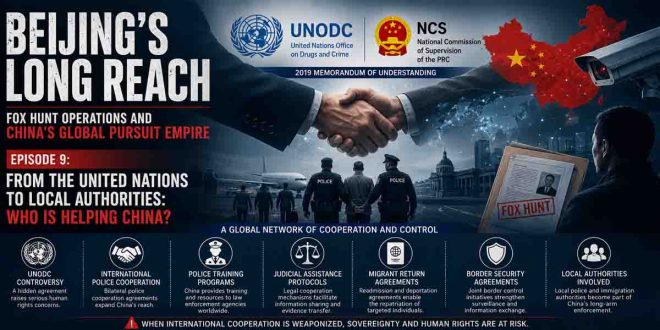
“How are global justice mechanisms and sovereign rights being weaponized under the guise of China’s transnational operations?” At first glance, the “Fox Hunt” and “Sky Net” operations orchestrated worldwide by the Beijing administration might appear to be isolated, covert actions carried out by Chinese agents on foreign soil. However, the flip side of the coin reveals a much more organized, shocking, and dangerous reality: Beijing does not act alone when executing its transnational repression and extrajudicial abduction mechanisms. The world’s most advanced global tracking empire derives its power not merely from its own intelligence apparatus, but from the bureaucratic loopholes of international institutions, blind spots in global oversight, and bilateral cooperation protocols signed by sovereign states.
While strategically leveraging legitimate global umbrellas like the United Nations Office on Drugs and Crime (UNODC) as systemic levers, the People’s Republic of China simultaneously “weaponizes” bilateral mutual legal assistance and police cooperation agreements. This cross-border network—openly reflected in the official legal texts of the Chinese Communist Party (CCP) and the candid admissions of the Central Commission for Discipline Inspection (CCDI)—effectively transforms local law enforcement agencies, immigration bureaus, and bureaucrats of target countries into voluntary or coerced enforcers of Beijing’s “long arm.”
How does this global wheel, which steadily shrinks the safe havens for dissidents, activists, and diasporas worldwide, continue to spin? How is international law subverted to serve the human hunt of an authoritarian regime? We dissect the anatomy of this systemic complicity, stretching from United Nations podiums straight to local police precincts.
1. The UNODC Controversy: The Hidden Partnership Between China’s National Supervision Commission (NSC) and the UN
Perhaps the most jarring exposure brought to light by the Safeguard Defenders report—one capable of causing a severe crisis of confidence in the international order—is the dark relationship between the United Nations Office on Drugs and Crime (UNODC) and the primary mechanism handling China’s transnational operations. Beijing has successfully co-opted the highest tier of the global system to legitimize its illegal tracking and repatriation strategies.
The Memorandum of Understanding Hidden from the Public
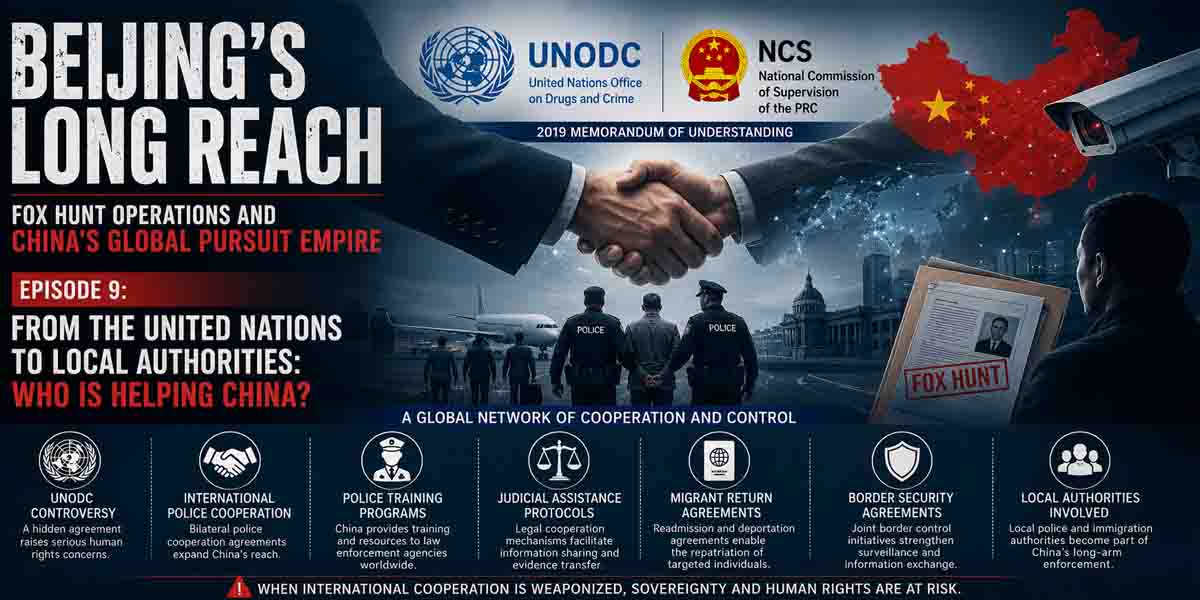
In 2019, a highly critical signing ceremony took place in Vienna. The UNODC, the very body tasked with shaping global crime and justice policies, signed an official “Memorandum of Understanding” (MoU) with the National Supervision Commission (NSC), which operates in absolute unison with China’s Central Commission for Discipline Inspection (CCDI).
The most striking aspect of this agreement, however, was the wall of secrecy erected by both parties. Completely violating fundamental transparency principles, the UNODC kept the text of this memorandum hidden from the public and human rights organizations for an extended period. Shielded from international oversight, the document was only brought to light after meticulous investigation by Safeguard Defenders, who published it in the appendix of their report. This tendency toward censorship and secrecy within a UN body demonstrates just how deeply Beijing’s diplomatic and financial leverage penetrates international institutions.
Not a Security Office, But the CCP’s Ideological Execution Institute: The NSC
The National Supervision Commission (NSC), with which the UNODC formally partnered, is by no means an independent, rights-respecting judicial law enforcement agency or judicial organ by international standards. On the contrary, the NSC is a totalitarian apparatus working as a single body with the CCDI—the highest disciplinary organ of the CCP—and is explicitly tasked with enforcing Party statutes and ideological loyalty.
According to China’s own domestic legislation and the official commentary attached to Article 52 of the National Supervision Law, the NSC is the direct architect and executor of operations (Fox Hunt / Sky Net) aimed at detaining individuals without judicial warrants, executing psychological terror under the label of “persuasion,” and unlawfully abducting targets abroad—particularly members of the East Turkestan diaspora, dissidents, and human rights defenders. For a UN agency to recognize such a structure as an official partner delivers a devastating blow to the spirit of international law.
Violation of the UN Human Rights Due Diligence Policy
The Safeguard Defenders report asserts that this cooperation between the UNODC and the NSC inflicts irreparable damage and raises grave questions regarding the United Nations’ own internal rules, specifically the UN Human Rights Due Diligence Policy (HRDDP).
Under UN mandates, any UN organ is strictly prohibited from providing support, entering into partnerships, or granting legitimacy to foreign state institutions that systematically violate human rights, engage in torture, carry out arbitrary detentions, or practice transnational repression. By collaborating with the NSC, the UNODC has:
-
Indirectly provided a global shield of legitimacy to the CCP’s extrajudicial “blackmail, family intimidation, and unlawful detention” mechanisms.
-
Allowed technical partnerships presented under the guise of “anti-corruption” and “international mutual legal assistance” to paint the NSC as a reputable partner in the global arena, enabling Chinese agents to operate with far greater ease on foreign soil.
The fact that an institution expected to deliver justice under the UN banner has been weaponized to legalize Beijing’s long arm globally stands as the most concrete proof of how the international system leaves human rights defenders and asylum seekers defenseless against authoritarian regimes.
2. China’s Security Diplomacy: The Institutional Network Behind “Fox Hunt”
To read Beijing’s transnational operations merely as sporadic intelligence actions or sudden police raids carried out covertly on the streets of foreign countries is to entirely miss the magnitude of the threat. “Fox Hunt” is far more than the illicit operations of Chinese operatives; it is the physical manifestation of a massive, meticulously woven “security diplomacy” strategy. By infiltrating the legal and administrative infrastructure of target nations, Beijing wraps its deniseashırı human hunt in an institutional cloak.
The multi-layered security diplomacy that feeds and validates China’s global tracking empire expands across several strategic pillars:
Global Police Training and Doctrine Transfer
Beijing offers extensive “police training programs” and equipment grants to law enforcement agencies across developing nations, particularly in Central Asia, Africa, Latin America, and Southeast Asia. These training sessions, held either within Chinese police academies or inside the host countries, go far beyond technical knowledge sharing. They serve to transfer China’s totalitarian social control methods, mass monitoring systems, digital surveillance capabilities, and authoritarian security doctrines directly to local police forces. Once local emniyet units internalize these doctrines, they begin viewing dissidents, activists, and refugees labeled as “criminals” or “terrorists” by Beijing as legitimate threats, thereby clearing the path for Chinese operations in the region.
Bilateral Security Agreements and Intelligence Integration
Through bilateral security agreements signed with dozens of countries worldwide, China integrates its own intelligence and security apparatus directly into the national security architectures of host states. These shadow agreements, frequently shielded from public view or wrapped in the pretext of “counter-terrorism,” allow Chinese security bureaucrats to exert direct diplomatic pressure on local authorities. Leveraging these pacts, Beijing can effortlessly obtain the location, communication logs, and financial data of a targeted individual via local intelligence pipelines.
The Weaponization of Mutual Legal Assistance Protocols
One of Beijing’s most frequent tactics is the ratification of bilateral Mutual Legal Assistance Treaties (MLATs). Because the Chinese judicial system completely lacks independence and operates under the direct command of the CCP, these treaties are routinely transformed into unilateral instruments of political persecution. Drafted under the nominal objective of “combating organized crime and corruption,” these adli yardımlaşma protocols serve as the primary legal cover for China to legitimize its fabricated charges, political prosecutions, and extradition requests behind the facade of international law.
Immigration Cooperation and Residency Cancellation Blackmail
The “persuasion to return” (back-to-home) strategy at the heart of “Fox Hunt” operations relies heavily on covert coordination with the immigration bureaus of host countries. China frequently invalidates the passports of targeted individuals unilaterally, then pressures cooperating foreign immigration departments to deny the renewal of visas, residency permits, or asylum statuses. Rendered “undocumented” overnight, stripped of legal protections, and facing imminent deportation, the victims are left highly vulnerable to the extortion and blackmail of Chinese state agents.
Border Security Agreements and Sealing Escape Routes
China maintains exceptionally rigid “border security and joint patrol” agreements with neighboring states, particularly across Southeast and Central Asia. These treaties legally bind local border guards to intercept individuals attempting to escape oppression or concentration camps to seek asylum in third countries (most notably Uyghurs from East Turkestan) the moment they cross the border. These individuals are routinely handed directly over to Chinese security forces without any formal judicial or asylum process being initiated.
This global security network effectively synthesizes foreign police forces, courts, immigration offices, and border guards into an overseas execution mechanism managed from a single center. “Fox Hunt” is therefore not a mere espionage affair; it is an institutionalized hunt for human beings, systematically fed by the bureaucratic gears of international law.
3. Police Cooperation Protocols: The Legalization of Sovereignty Violations
The field data compiled by Safeguard Defenders exposes exactly how the People’s Republic of China has expanded its overseas operational capacity through police cooperation memorandums, joint operational mechanisms, and migrant readmission agreements.
This institutional framework proves that “Fox Hunt” and “Sky Net” are not merely clandestine operations; they are institutionalized with the systemic compliance and legal loopholes of the host countries. The deep footprint China has established through this strategy across Southeast Asia and the Pacific aligns perfectly with verified field research and regional reporting.
CHINA'S GLOBAL POLICING COOPERATION MODEL
[Police Cooperation MoU] ──> [Joint Operation Mechanisms] ──> [Readmission & Deportation]
           │                                 │                                │
 (Granting Legal Status)          (Integration of Field Agents)     (Extrajudicial Return/Abduction)
Total Blockade in Southeast Asia: Laos, Myanmar, and Indonesia
Southeast Asia is the primary geography where China executes its cross-border repression and forced return mechanisms most aggressively, aiming to convert the region into its geopolitical backyard.
-
Laos: One of the earliest countries to sign cross-border security and extradition protocols with China. Utilizing migrant readmission agreements, Beijing works alongside Laotian authorities to immediately detain activists and asylum seekers using the country as a transit corridor, swiftly deporting them back to China.
-
Myanmar: The governance vacuum in the northern border regions and deep political-military dependence on Beijing allow elements of China’s Ministry of Public Security (MPS) to operate directly on Myanmar soil. Joint patrols and counter-terrorism covers provide “Fox Hunt” teams with virtually unrestricted operational freedom.
-
Indonesia: Through mutual legal assistance and police memorandums signed with Jakarta, China has legalized the presence of its own intelligence teams, allowing them to hunt “suspects” on Indonesian soil alongside local police.
Power Projection in the Pacific: Fiji and Vanuatu
Beijing’s long arm reaches well beyond land borders, extending deep into the Pacific islands, signaling that its global tracking empire recognizes no geographic boundaries.
-
Fiji and Vanuatu: China entered into police cooperation protocols with these small island nations under the guise of “capacity building,” “police training,” and “security equipment assistance.” As documented by Safeguard Defenders, these protocols enabled elite Chinese operatives to land on the islands, directly command local law enforcement, track targeted individuals, bypass standard extradition procedures, and fly victims back to China on chartered state aircraft.
Overseas Execution Cloaked as “Joint Operations”
The most perilous dimension of these protocols is how they turn foreign law enforcement into de facto branches of China’s transnational execution machinery. Under joint operational frameworks, Chinese agents reside in foreign nations under official titles like “advisors” or “liaison officers.” Local immigration offices and counter-terrorism units, acting on fabricated intelligence dossiers supplied by Beijing, revoke the residency permits of targets and hand them over to Chinese operatives.
These police cooperation agreements ultimately result in sovereign nations surrendering their sovereign rights, consenting instead to serve Beijing’s global dragnet.
4. Local Governments and Indirect Support: Are Global Law Enforcement Agencies Serving the CCP?
The core question raised by the Safeguard Defenders report remains highly critical for the international community: “Are local police forces and certain governments becoming an extension of China’s transnational operations?”
The data indicates a deeply concerning trend. By utilizing its economic and diplomatic leverage, Beijing has managed to turn local administrations, municipalities, and police departments within target nations into subcontractors for its extraterritorial punishment organs (the NSC and CCDI). Law enforcement personnel wearing the official uniforms of sovereign nations are increasingly acting on directives originating from Beijing.
This indirect support is exacted through three primary methods:
“Joint Raids” on Targeted Addresses
Beijing frequently reports dissidents, human rights defenders, or asylum seekers to local authorities using fabricated allegations, labeling them “international fraudsters,” “terrorists,” or “crypto-currency scam leaders.” Local police departments, seldom questioning the underlying political motivations, conduct dawn raids on these individuals’ homes using logistics and intelligence provided by Chinese liaison officers. During these joint raids, Chinese operatives are often physically present alongside local police, seizing digital materials and initiating psychological pressure directly at the scene.
Bypassing the Rule of Law with “Bulk Deportations”
Under established international law and non-refoulement principles, states are strictly prohibited from returning individuals to countries where they face a verifiable risk of torture or persecution. However, various local governments and immigration authorities under Beijing’s influence bypass prolonged court procedures by triggering “administrative deportation” mechanisms. The report documents instances, particularly in Southeast Asia and Africa, where local administrations have rounded up dozens of asylum seekers at China’s request, denied them access to legal counsel, and transferred them en masse to waiting Chinese state-chartered aircraft.
Legal Espionage Masked as “Joint Investigations”
“Joint investigation committees” established between Beijing and local police headquarters provide Chinese intelligence officers with legal immunity to conduct espionage on foreign soil. Under the umbrella of a joint investigation, local police track physical movements, gather telecom data (HTS logs), monitor bank accounts, and map family connections, subsequently feeding this data directly to China. Consequently, the CCP effectively commands the official intelligence and law enforcement infrastructure of a foreign state, utilizing its budget and personnel for Beijing’s domestic security priorities.
The compliance of local administrations, municipalities, and police chiefs in the face of Beijing’s “security assistance,” “technological infrastructure grants” (such as facial recognition and surveillance systems), or direct diplomatic pressure remains a primary reason why “Fox Hunt” operations maintain a high rate of execution globally.
5. The Critical Debate: From a “Fugitive Repatriation” Action to a Global Policing Power
The ultimate conclusion drawn from the analysis of the Safeguard Defenders report concerns the strategic end-game of China’s transnational operations. The report clarifies that viewing Beijing’s international influence solely through the lens of massive economic initiatives like the Belt and Road Initiative is a significant analytical error. China’s global hegemony is expanding concurrently through security institutions, partnerships with international organizations, police diplomacy, and bilateral treaties.
The critical insights derived from this comprehensive analysis reveal:
The Weaponization of Security Structures and International Alliances
The Beijing administration systematically utilizes partnerships with international bodies to inject its authoritarian legal norms into the global governance framework. Alliances forged with reputable umbrella organizations, such as the UN, provide an artificial layer of “international legitimacy” to totalitarian Chinese structures like the NSC and CCDI when operating abroad, allowing Beijing to manipulate global security architecture from within.
The Reconfigured Role of Police Diplomacy and Bilateral Treaties
Spanning from developing nations to Western capitals, police diplomacy and bilateral judicial pacts have transitioned away from standard, routine crime-fighting instruments. China utilizes these agreements to penetrate the legal sovereignty of host states, integrate local law enforcement into its domestic intelligence apparatus, and strip human rights defenders and the East Turkestan diaspora of their legal protections.
The Extraterritorial Expansion of Policing Capabilities
The comprehensive data yields a definitive conclusion: The “Fox Hunt” and “Sky Net” operations are absolutely not simple “fugitive recovery” or “anti-corruption” campaigns. This mechanism is a systematic project designed to expand Beijing’s extraterritorial policing capacity, establish its legal authority within the territories of sovereign nations, and build a parallel global justice and execution system.
By exploiting loopholes in international law and capitalizing on the bureaucratic vulnerabilities of foreign states, China is forging a totalitarian “global policing power” capable of operating far beyond its borders without the need for independent judicial warrants. This modern variant of security imperialism poses a fundamental challenge not only to targeted individuals but to the future of international law and state sovereignty.
East Turkestan Bulletin News Agency / NEWS CENTER
Sources & References
1. International Reports & Civil Society Organizations
-
Safeguard Defenders
-
Website: https://safeguarddefenders.com
-
(Comprehensive investigations on “Fox Hunt” and “Sky Net” operations, transnational repression networks, and police cooperation protocols.)
-
-
Amnesty International
-
Website: https://www.amnesty.org
-
(Reports on human rights violations in China, arbitrary detentions, and the crisis in East Turkestan.)
-
-
Human Rights Watch (HRW)
-
Website: https://www.hrw.org
-
(Analysis of China’s security policies, transnational repression targeting the diaspora, and violations of international law.)
-
-
International Consortium of Investigative Journalists (ICIJ)
-
Website: https://www.icij.org
-
(Investigative tracks on global surveillance systems, interstate data sharing, and cross-border security networks.)
-
2. United Nations & Official International Bodies
-
United Nations Office on Drugs and Crime (UNODC)
-
Website: https://www.unodc.org
-
(Frameworks on international judicial cooperation and combating transnational organized crime.)
-
-
United Nations Human Rights Office (OHCHR)
-
Website: https://www.ohchr.org
-
(Global legal standards regarding non-refoulement, arbitrary detention, and universal human rights.)
-
-
United Nations Treaty Collection
-
Website: https://treaties.un.org
-
(Official database for interstate mutual legal assistance and bilateral extradition treaties.)
-
3. Chinese Official Institutions & Legal Documents
-
Central Commission for Discipline Inspection (CCDI)
-
Website: https://www.ccdi.gov.cn
-
(The Chinese Communist Party’s disciplinary mechanism and anti-corruption frameworks.)
-
-
National Supervisory Commission (NSC)
-
Website: http://www.npc.gov.cn
-
(The structural state supervision system and official texts of China’s National Supervision Law.)
-
-
Ministry of Public Security of the PRC (MPS)
-
Website: https://www.mps.gov.cn
-
(Official press releases on China’s public security operations and international police cooperation.)
-
4. Academic Journals & Security Analysis Reports
-
Council on Foreign Relations (CFR) – China Global Security Reports
-
Website: https://www.cfr.org
-
(Strategic analysis of China’s global security footprint and police diplomacy.)
-
-
Brookings Institution
-
Website: https://www.brookings.edu
-
(In-depth analysis of Chinese foreign policy, the Belt and Road Initiative, and global security integration.)
-
-
Chatham House – China Research
-
Website: https://www.chathamhouse.org
-
(Research on China’s institutional influence within the international system and bilateral state alliances.)
-
5. Investigative Journalism & Global Media Networks
-
Reuters Investigations
-
Website: https://www.reuters.com
-
(Investigative reporting on China’s international covert operations and diplomatic leverage.)
-
-
BBC News – China Watch
-
(Global monitoring of China’s foreign policy and cross-border security agenda.)
-
The Guardian – Global China Investigations
-
Website: https://www.theguardian.com
-
(In-depth coverage of China’s global reach, human rights violations, and pressure on diaspora communities.)
-


