Doğu Türkistan Haberleri – Son Dakika – Uygur Haber Ajansı Doğu Türkistan Haberleri ve Çin haberleri; toplama kampları, istihbarat savaşları, İnterpol suiistimalleri, sınır ötesi Uygur avı ve küresel PSC tehdidi analizleri.


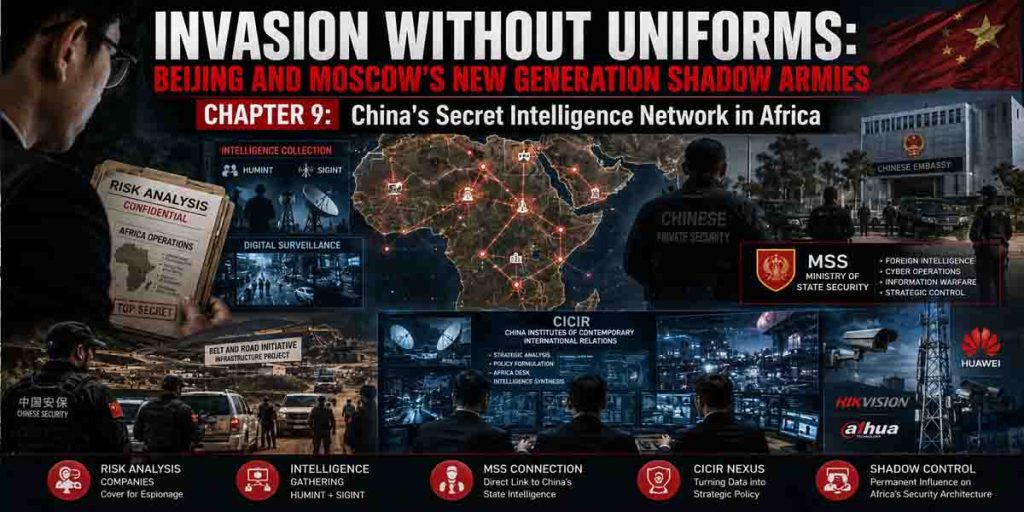
For a long time, the People’s Republic of China’s (PRC) presence on the African continent has been analyzed primarily through the lens of economic investments, mining operations, and massive infrastructure projects under the Belt and Road Initiative (BRI). However, Beijing’s vital need to protect its billions of dollars in assets and thousands of personnel on the ground has necessitated the establishment of a sophisticated intelligence and security architecture that goes far beyond mere commercial expansion.
The most strategic and invisible component of this architecture is a covert intelligence network woven by Chinese Private Security Companies (PMSCs) and their subsidiaries, operating quietly under the shadow of official military bases or diplomatic missions. To avoid triggering direct sovereignty crises on the continent, Beijing cloaks traditional espionage methods under the guise of “risk analysis” and “corporate security,” implementing a new-generation intelligence doctrine.
1. Risk Analysis Companies: The Legitimate Mask of Espionage
The forward outposts of China’s covert intelligence-gathering apparatus in Africa consist of Chinese-owned risk analysis companies that position themselves in the global market as “independent consultancy firms.”
- Infiltration and Camouflage: By structuring themselves as standard commercial enterprises, these firms comfortably maneuver within target countries without tripping local regulatory radars or international oversight. Beijing’s state strategy strictly bars independent Western cyber-security or risk assessment firms from critical infrastructure projects, as their involvement poses an unacceptable data leakage risk to the PRC.
- Technical Infrastructure and System Integration: These risk analysis firms work in lockstep with field-deployed Chinese PMSCs to map out the security landscapes of various projects. However, this mapping covers far more than physical threats; it systematically charts local government vulnerabilities, the leadership cadres of dissident movements, trade union activities, and the military-economic maneuvers of rival global powers (such as the US, France, and Russia). This corporate risk management cover grants Beijing legal, direct, and “legitimate” access to a target nation’s most sensitive security and intelligence data.
2. Intelligence Gathering: From the Field to Data Centers
China’s intelligence-gathering operations across Africa rely on a seamless fusion of Human Intelligence (HUMINT) and Signals Intelligence (SIGINT).
- Manipulation of Local Networks: By leveraging their mandates to train and provide logistical support to local law enforcement, Chinese security companies forge organic ties with domestic police and intelligence units. This grants them a backdoor into local intelligence pools, enabling them to harvest critical field data through bribery, leverage, and influence operations.
- Digital Data Harvesting: The technical backbone of this intelligence harvesting is fed by “Safe City” infrastructures built by state-backed tech giants like Huawei, Hikvision, and Dahua. Massive streams of raw data pulled from smart cameras, biometric scanning hubs, and local servers are processed directly by Chinese risk analysis experts. This collected data is utilized far beyond mitigating local security threats; it serves as strategic leverage to compromise, influence, or steer the political elites of African nations.
3. The MSS (Ministry of State Security) Connection: Who Pulls the Strings?
The claim that Chinese private security and risk analysis firms are “private” or “independent” is an absolute illusion when viewed through the prism of Beijing’s Civil-Military Fusion doctrine. The ultimate orchestrator behind these structures is the Ministry of State Security (MSS)—the PRC’s primary apparatus for foreign intelligence and cyber espionage.
- Structural and Organic Links: Unlike Western PMSCs, the executive tiers of Chinese security and risk analysis firms are densely populated by former MSS operatives, retired People’s Liberation Army (PLA) officers, and specialists graduated from state intelligence academies.
- Statutory Obligation and Intelligence Subcontracting: Under China’s National Intelligence Law, all Chinese corporations and citizens are legally mandated to cooperate with state intelligence organs and hand over any requested data. Consequently, a Chinese security firm operating in an African theater functions practically as an operational and Open-Source Intelligence (OSINT) subcontractor for the MSS. Sensitive diplomatic, military, and economic data gathered under the banner of routine risk assessments are channeled directly to MSS headquarters in Beijing via encrypted links.
4. The CICIR Nexus: Strategic Analysis and Policy Formulation
To transform this massive influx of raw field data into actionable state policy, Beijing activates the China Institutes of Contemporary International Relations (CICIR).
- The Brain of the MSS: While outward-facing as a conventional academic think-tank, CICIR is directly subordinate to the Ministry of State Security (MSS). It functions as the premier intelligence-analysis organ reporting directly to the highest echelons of the Chinese Communist Party (CCP), such as the Central Foreign Affairs Commission.
- Shaping the African Strategy: Every field brief routed by Chinese risk analysis firms and PMSCs in Africa is dissected at CICIR’s dedicated African and cyber-security desks. CICIR analysts leverage this covert intelligence pool to calibrate Beijing’s macro-maneuvers: identifying imminent coup risks, pinpointing which local leaders to co-opt with backroom deals, and devising ways to neutralize Western competitors threatening Chinese investments.
In summary; China’s footprint in Africa is not limited to mere commercial entities operating ports and mines. Behind the curtain lies a tightly integrated, multi-layered Covert Intelligence Network—masked by risk analysis firms, fed from the ground by PMSCs, directed by the MSS, and synthesized into geopolitical policy by CICIR. This network forms the quietest, yet most lethal cog in Beijing’s “occupation without uniforms” grand strategy.
Dear Readers,
In this striking installment of our investigative series, Occupation Without Uniforms, we decipher the invisible mechanisms hidden beneath Beijing’s economic hegemony on the African continent. Under the pretext of safeguarding its multi-billion-dollar investments, China is systematically deepening China’s secret intelligence network in Africa day by day. The initial wave of this multi-layered infiltration is led by risk analysis companies that present themselves on the ground as independent consultancy firms. Operating under the mask of legitimate commercial actors, these entities meticulously map and report the most intimate security vulnerabilities of target nations.
The data harvested from the field goes far beyond standard observation; it is executed through expansive information gathering activities that fuse human intelligence with digital surveillance networks. The true governing force driving these private security firms and analytical frameworks operates directly through deep-seated MSS connections, tying them directly to China’s global espionage and cyber-operations apparatus. Once this sensitive raw data is gathered from the ground, the process of synthesizing it into macro-policies and strategic chess moves for the Chinese Communist Party is finalized via CICIR relations—the state’s premier intelligence brain masquerading as a public think-tank.
Within this integrated matrix, Pekin shadow armies and field-deployed Chinese private security companies assume an active role, safeguarding the physical anchors of this global espionage network. Orchestrated by the state’s civil military fusion doctrine, this entire commercial and intelligence footprint is directed from a singular nexus, establishing permanent leverage over the Africa security architecture. The outputs yielded by this continuous strategic intelligence analysis offer definitive proof of just how profound a threat the concept of occupation without uniforms poses to the modern world.
REFERENCE:
Publisher: FRS (Fondation pour la recherche stratégique / Foundation for Strategic Research – Paris) Publication Date / No: No. 03/2025 – March 2025