 Doğu Türkistan Haberleri – Son Dakika – Uygur Haber Ajansı Doğu Türkistan Haberleri ve Çin haberleri; toplama kampları, istihbarat savaşları, İnterpol suiistimalleri, sınır ötesi Uygur avı ve küresel PSC tehdidi analizleri.

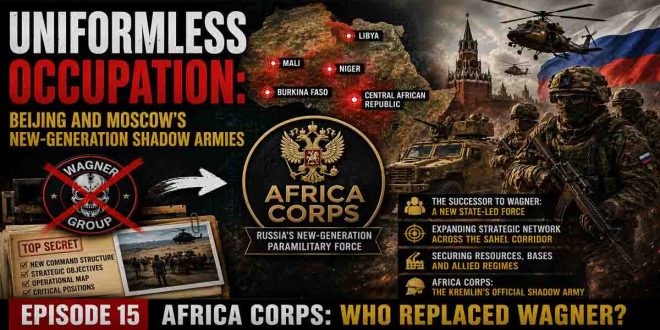
Following the liquidation of Yevgeny Prigozhin, Russia’s paramilitary presence in Africa has undergone a complete metamorphosis. According to institutional data from the FRS report, the Africa Corps—which has replaced Wagner’s lawless and unpredictable structure—has transformed into a new-generation military apparatus that places Moscow’s asymmetric power instruments directly under state monopoly.
Following the death of Wagner Group founder Yevgeny Prigozhin, global public expectations that Russia’s African operations would collapse have proven completely unfounded. Instead of leaving billions of dollars worth of military, political, and economic legacy unattended, the Kremlin executed one of the largest institutional transformations in the history of asymmetric warfare. Wagner’s “deniable” structure operating in legal gray zones was dismantled, and the “Africa Corps” was forged as a direct extension of the Russian state apparatus. This new paramilitary deployment elevates Russia’s “uniformless occupation” of the continent to the most institutional tier of its Class 4 hybrid actor model.
1. Institutional Structure: A State Army Born from Wagner’s Ashes
According to FRS analyses, the Africa Corps is not a “private enterprise” hiding behind front companies, oligarch networks, or shadow financial funds. It is an official military structure directly integrated into the Russian Ministry of Defense.
- Personnel Absorption: The Africa Corps has largely absorbed Wagner’s seasoned field personnel, commanders, and technical specialists who were hardened on battlefields across Syria, Ukraine, and Africa. However, this transition was strictly conditional upon personnel swearing an oath of allegiance directly to the Russian state rather than a private corporation.
- Regular Army Standards: The structure put an end to Wagner’s wild-capitalism-driven and booty-oriented reward system, subjecting all personnel to the official salary scales, social benefits, and military logistics standards of the Ministry of Defense.
- Liquidation of Parallel Structures: All financial front networks, aviation shell companies, and logistical lifelines utilized during the Prigozhin era were canceled, hooking the entire system directly into the official transport and supply chain of the Russian military.
2. Command System: Dual-Headed Control by the GRU and Ministry of Defense
Wagner’s ultimate vulnerability was its chain of command, which could be swayed by Prigozhin’s personal and commercial ambitions independent of the Kremlin. With the Africa Corps, this risk has been entirely eliminated. The structure’s command system is tied to a rigid military hierarchy routed directly to Moscow:
- Direct Ministry Control: The highest management tier of the Africa Corps answers directly to Russian Deputy Defense Minister Yunus-bek Yevkurov and the General Staff of the Russian Armed Forces. Yevkurov personally sits at the negotiation tables with African leaders as the official guarantor of the state.
- Intelligence-Driven Command (GRU): Operational command, intelligence gathering, reconnaissance, and strategic planning on the ground are under the direct oversight of the Russian Military Intelligence Service (GRU). Senior generals from the GRU’s asymmetric operations divisions serve as the clandestine brain trust of the Africa Corps. Consequently, unpredictable actors like Prigozhin have been replaced by a bureaucratic military mind serving the Kremlin’s exact geopolitical objectives.
3. Operational Theaters: Russia’s New Map on the Continent
The Africa Corps has not only taken over all strategic outposts where Wagner set foot but is also expanding its operational boundaries to consolidate Russia’s permanent military presence across the Mediterranean and Sub-Saharan Africa. According to the FRS report, the primary operational bases and missions of the structure include:
- Mali and Burkina Faso (The Sahel Corridor): In these nations ruled by anti-Western military juntas, the Africa Corps acts as a direct combat force on the front lines. It trains local armies, spearheads operations under the guise of counter-terrorism, and guarantees the physical security of the regimes.
- Libya (The Strategic Logistics Hub): Eastern Libya (territory controlled by Haftar) serves as the main logistical, transit, and air base hub for all of the Africa Corps’ pan-African operations. Military cargo planes departing from Moscow distribute personnel and ammunition to Sub-Saharan Africa via Libya.
- Central African Republic (CAR): In this country, which served as Wagner’s initial laboratory, the Africa Corps continues to secure gold and diamond mining concessions. However, it now routes the generated revenues directly to state-owned enterprises controlled by the Kremlin.
- Niger and Beyond: The structure has recently signed official security pacts with the junta regime in Niger, moving directly into strategic outposts vacated by departing U.S. and French military forces.
4. Direct Kremlin Oversight and the Future of Hybrid Warfare
The Africa Corps model represents a radical philosophical shift in Russia’s hybrid warfare doctrine. While “plausible deniability” was paramount during the Wagner era—allowing the Kremlin to brush off field atrocities and operations by claiming “no state ties”—Russia has now turned its African military presence into an overt, proudly claimed “official state policy.”
While this absolute Kremlin oversight makes the structure more disciplined and heavily funded, it also introduces bureaucratic bottlenecks that hinder its agility and speed on the ground. FRS analyses highlight that this transitional phase—where Russia suffers institutional growing pains and gets bogged down in regular army red tape—is being closely watched by China. Beijing continues to silently safeguard its economic interests through more compliant, law-abiding “Class 2” commercial security firms. While Moscow attempts to dominate regimes through raw military muscle and an institutional military apparatus, Beijing quietly expands its economic and intelligence footprint right under this Russian military umbrella.
Editor’s Note:
In this 15th chapter of Uniformless Occupation, we dissect the institutional anatomy of the new actor that has replaced Wagner in the vacuum left by Prigozhin’s liquidation. We expose how this force sits squarely at the heart of the Russian Ministry of Defense Africa strategy and how it is run by the GRU Africa command apparatus—the covert cells of the military intelligence service. While auditing the new protocols signed with continental junta regimes by diplomatic-military delegations led by Deputy Defense Minister Yunus-bek Yevkurov, we analyze the ongoing turf war over Russia Africa operasyon bölgeleri (Russian operational theaters in Africa).
By deconstructing how asymmetric assets have been fully nationalized under the concept of Kremlin-controlled shadow armies, we look at how this institutionalization is disrupting the broader African private military companies market. This study documents how Beijing is tracking Moscow’s bureaucratic slowdown to gain an edge in the Sino-Russian security competition in Africa, offering an unprecedented resource on the global anatomy of paramilitary structures.
REFERENCE:
Publisher: FRS (Fondation pour la recherche stratégique / Foundation for Strategic Research – Paris) Publication Date / No: No. 03/2025 – March 2025


