Doğu Türkistan Haberleri – Son Dakika – Uygur Haber Ajansı Doğu Türkistan Haberleri ve Çin haberleri; toplama kampları, istihbarat savaşları, İnterpol suiistimalleri, sınır ötesi Uygur avı ve küresel PSC tehdidi analizleri.

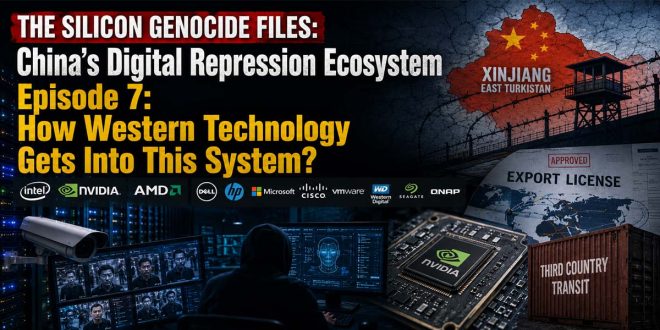
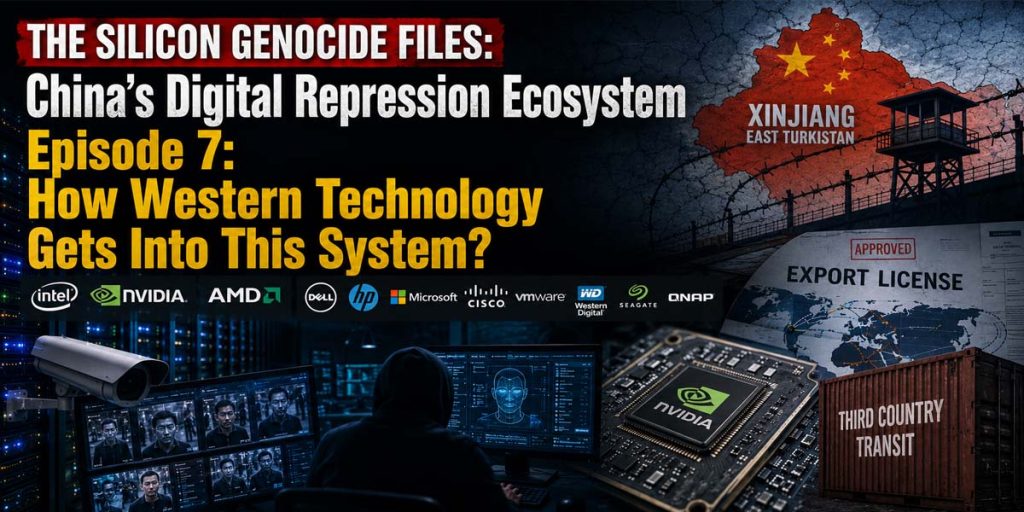
One of the greatest misconceptions regarding the massive digital surveillance apparatus established by China in East Turkestan—and the data centers that form the heart of this mechanism—is the belief that international sanctions and export restrictions have completely severed Beijing’s access to Western technology. However, the “Hardwired Repression” report published by C4ADS shatters this perception, revealing a far more complex, hybrid, and porous supply chain landscape.
While Beijing aggressively finances its “indigenization” (国产化) policy in critical technologies, it continues to rely heavily on hardware of American and Taiwanese origin to sustain modern surveillance across data centers in East Turkestan.
1. The “Free” Flow Beneath Sanction Thresholds
The most significant legal loophole allowing Western technology to infiltrate this ecosystem is the export control thresholds. Artificial intelligence restrictions imposed by the US and its allies on China are generally limited to top-tier, high-performance “military/strategic” chips. However, these cutting-edge chips are not always required for mass data processing, facial recognition, and camp surveillance systems in East Turkestan.
The Yanqi Vocational Technical School “Smart Campus” surveillance project, analyzed in the report, serves as a striking example. In these schools, which function as assimilation and forced labor camps for Uyghur youth, students’ movements, meal times, and dormitory entries are monitored in real-time using Western chips.
- The database and facial recognition servers of this project utilize Intel Core i5 and i7 processors, while Nvidia GeForce RTX 4060, RTX 4060 Ti, RTX 3050, and AMD Radeon RX 7600 graphics cards are deployed for AI-powered visual processing.
- Because these components are classified as commercial-grade (consumer-oriented) and fall below sanction thresholds, they flow into China through legal channels without facing any obstacles. Consequently, they feed the computational backbone used for the systematic tracking of the Uyghur population.
2. The Infrastructure Compatibility Mandate of Global Giants
An examination of the 2024–2025 procurement specifications for official data center projects in East Turkestan reveals that Chinese authorities strictly mandate full compatibility with technologies from Dell, HP, Microsoft, Cisco, VMware, Western Digital, Seagate, and Taiwan’s QNAP.
Although China promotes domestic alternatives like Huawei, Inspur, or Tencent Cloud, strategic reasons drive the permanence of Western technology in these data centers:
- The Difficulty of Transition: China’s existing surveillance infrastructure is already built upon Western technologies. Since a complete transition to a fully domestic ecosystem requires immense time and capital, the interoperability of hybrid systems remains mandatory.
- Risk Management for Future Policies: By continuing to demand Western hardware—the global industry standard—Beijing aims to keep its systems integrated with global networks in anticipation of a potential easing of sanctions in the future.
3. Smuggling and Third-Party Supply Chains (Transshipment)
When it comes to high-end AI chips subject to official export restrictions, China’s global smuggling networks and front companies step in. According to a Bloomberg analysis, Chinese firms plan to install more than 115,000 restricted Nvidia AI chips in data centers across East Turkestan and the neighboring Qinghai province. Once the chips leave the factory, inadequate post-shipment verification allows them to be repackaged or rerouted through third countries, ultimately ending up in surveillance servers across East Turkestan.
4. Corporate Opacity and Legal Loopholes
Another factor facilitating the infiltration of Western technology and capital into the system is the convoluted corporate structure of Chinese State-Owned Enterprises (SOEs). China Telecom Xinjiang, which operates at least four major data centers in East Turkestan and has signed direct surveillance and data-processing contracts with the sanctioned paramilitary organization—the Xinjiang Production and Construction Corps (XPCC)—is the clearest example.
The parent company, China Telecom, was added to the US “Chinese Military-Industrial Complex Companies” list and delisted from the New York Stock Exchange. However, due to a loophole in international sanction regimes, these restrictions do not automatically extend to the company’s provincial-level subsidiaries, such as China Telecom Xinjiang. As a result, global technology manufacturers and distributors continue their commercial relations with these sub-entities on the grounds that they are “not directly listed,” thereby indirectly supplying components to the genocide infrastructure.
The “Silicon Genocide” is not limited to cameras or algorithms manufactured solely by China. Western hardware—flowing through the capillaries of global supply chains, sold on the open market, or brought into East Turkestan by exploiting legal loopholes—powers the very data centers where the biometric data, communication logs, and ethnic profiling maps of millions of people are processed today. Whether consciously or by turning a blind eye, the West continues to provide the hardware foundation for the digital prison in East Turkestan using technology developed in its own laboratories and factories.
Dear Readers
In this highly anticipated installment of our investigative series, we dive deep into how the china digital repression ecosystem continues to thrive despite global restrictions. While many believe that international embargoes have completely isolated the region, the landmark c4ads hardwired repression report reveals a shocking reality about the infrastructure driving this crisis.
Our investigation exposes how standard western technology sanctions are being bypassed through critical regulatory loopholes. In places like the controversial Yanqi project, uyghur smart campus surveillance relies on commercial-grade processors and graphics cards to track students in real-time. This reveals a systemic vulnerability where global brands unintentionally reinforce the xinjiang digital infrastructure.
When higher-end hardware is restricted, a sophisticated network of china chip smuggling and front companies takes over. Despite strict nvidia china restrictions and a broader ai chip embargo, tens of thousands of advanced chips are rerouted through third countries to reach east turkestan data centers.
Furthermore, local state-owned operators like china telecom xinjiang exploit corporate opacity to sign surveillance contracts while remaining unpunished under current legal frameworks. Ultimately, this silikon soykırımı (silicon genocide) is a crisis deeply connected to a porous global technology supply chain.
We invite you to read the full English analysis of Part 7 on our platform to uncover how global tech inadvertently fuels this digital prison.