 Doğu Türkistan Haberleri – Son Dakika – Uygur Haber Ajansı Doğu Türkistan Haberleri ve Çin haberleri; toplama kampları, istihbarat savaşları, İnterpol suiistimalleri, sınır ötesi Uygur avı ve küresel PSC tehdidi analizleri.

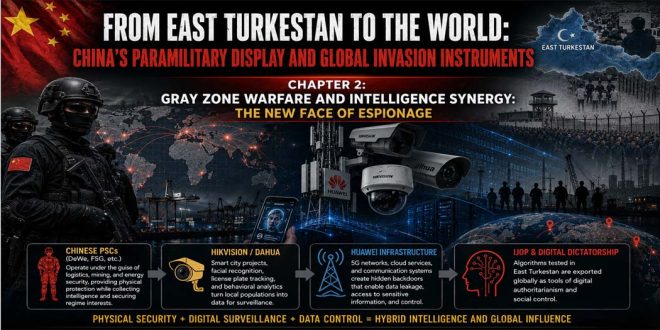
The world military literature uses a new term to define that insidious, unidentifiable gap between hot conflict and peacetime: “Gray Zone Warfare”. This strategy aims to seize the sovereignty of the target country step-by-step through front structures, without directly declaring war, triggering a diplomatic crisis, and most importantly, without deploying regular army units to the field.
The Beijing administration is the actor that most aggressively applies this doctrine, which it developed to infiltrate through the loopholes of international law, on a global scale. Operating on the principle of “not war, but not peace either,” the Chinese Communist Party (CCP), instead of using tanks and rifles to occupy countries along the Belt and Road Initiative route, deploys a hybrid shadow force consisting of state-driven companies, economic debt traps, and front private security companies (PSCs).
1- Companies Instead of Tanks: The Operational Scheme of Gray Zone Invasion
In China’s Gray Zone strategy, so-called “Private” Security Companies are not merely watchmen protecting commercial facilities, but are Beijing’s cross-border physical frontier lords. While traditional military interventions lead to sanctions at the United Nations (UN) level and international crises, when China deploys thousands of “security guards” to an African or Central Asian country, this situation legally appears as a “commercial contract.”
In this way, Beijing:
- Takes physical control of strategic ports, mineral deposits, and energy lines without enduring the cost and diplomatic resistance of opening a military base in the target country.
- Can evade responsibility by saying, “It has nothing to do with us, it is a local incident of a private firm,” when the paramilitary personnel on the ground engage in a local conflict or get involved in a rights violation.
- Builds a de facto sphere of sovereignty by infiltrating fragile regions or regions carrying a risk of civil war, where regular armies (PLA) cannot legally set foot.
The Chinese model, contrary to the high-profile operations of Western private military companies or the direct fear and hot conflict generation strategy of Russian mercenary structures, follows a silent expansion model based on low visibility, camouflaged with economic investments, and building long-term influence. In this strategy, commercial contracts replace military uniforms, infrastructure projects replace tanks, and the rhetoric of security, logistics, and investment partnership replaces the appearance of a direct invasion. According to security experts, this approach is one of China’s most important “gray zone” advantages, enabling it to establish permanent spheres of influence in critical geographies without drawing international backlash.
2- From the Guard at the Gate to the Intelligence Station: The New Cells of Espionage
The most dangerous breaking point that distinguishes Chinese security firms from their Western counterparts is that these structures operate like “Intelligence Stations” that directly connect the logistical and data flow on the ground to the intelligence pool in Beijing. Chinese PSC personnel do not merely guard the gates in the strategic regions they go to; they establish a complete data monopoly through logistics, local network integration, and field intelligence.
Critical data obtained on the ground (movements of local politicians, topographical and infrastructural vulnerabilities of the region, social dynamics, and port/airport cargo traffic) is gathered at the company’s operations center. From there, in accordance with the legal obligation imposed by the 2015 National Security Law, it is served as raw data (intelligence) directly to the Chinese Ministry of State Security (MSS) and military intelligence units.
3- Export of Digital Fascism: The Insidious Partnership of Paramilitary Forces and Tech Giants
Beijing’s biggest multiplier in Gray Zone warfare is the cyber-physical synergy established between the paramilitary field power and Chinese tech giants. All ports, railways, mining sites protected by companies like DeWe Security, Huaxin ZhongAn, or FSG, and even local municipal infrastructures taken over under the name of the “Safe City” project, turn into parts of China’s global surveillance network.
The “Safe City” projects, which China has aggressively expanded in recent years across Africa, Central Asia, and the Balkans, are marketed in official rhetoric for the purposes of reducing crime rates, traffic control, and public safety. However, the projects carried out in countries such as Pakistan, Kenya, Uganda, Zambia, Ecuador, and Serbia are criticized by international human rights organizations and cybersecurity experts not merely as a security system, but as an infrastructure for centralized data collection, biometric tracking, and mass surveillance. The AI-backed facial recognition systems, city cameras, license plate reading networks, and centralized data centers used in these projects spark debate on the grounds that they create a next-generation digital control mechanism operating simultaneously on the ground between Chinese tech companies and the PSC ecosystem.
- Hikvision and Dahua Cameras (Physical Surveillance): As a first order of business, Hikvision and Dahua’s thermal cameras equipped with AI, facial recognition, and license plate reading features are installed in every facility where Chinese security companies are deployed. These AI algorithms, which were developed in East Turkestan to track, profile, and lock away Uyghur Turks in concentration camps step-by-step, are integrated into the facilities protected by these companies. Thus, all local residents, bureaucrats, and military elements around the facility enter China’s digital radar.
- Huawei Infrastructure and Data Backdoors: The massive data traffic obtained from cameras and digital systems on the ground is carried over 5G networks, cloud servers, and telecommunications infrastructure established by Huawei. As proven repeatedly in international cybersecurity reports, hidden backdoors embedded within these devices ensure that the entire data flow is leaked to the main servers in Beijing, without the local governments even being aware.
The Terrifying Result of the Synergy: China has merged the operational intelligence it collects physically on the ground through front security companies with the cyber-intelligence power of Hikvision, Dahua, and Huawei. This situation means that countries signing onto the Belt and Road initiative surrender not only their resources, but also their national sovereignty, digital data, and state secrets. The digital concentration camp model established in East Turkestan is being transformed step-by-step into a global network of captivity today through this front ecosystem.
4- Export of Oppression from the Laboratory to the World: The IJOP Algorithm
Occupied East Turkestan is the sole patent holder and the first place of application in the world for China’s cyber-paramilitary espionage model. Huawei and Hikvision, which market “Smart City” or “Safe Zone” projects to every African and Central Asian country they visit, are in fact exporting the global version of the IJOP (Integrated Joint Operations Platform) algorithm, which was perfected by being tested on the tears, blood, and data of millions of Uyghur Turks in East Turkestan.
This digital fascism software, which hunts down Uyghur Turks in East Turkestan with ethnic identity recognition, AI-backed facial scanning, and license plate reading algorithms, and locks them into concentration camps without trial, is used today as a cyber weapon to profile local people, bureaucrats, and military elements in foreign facilities and ports protected by Chinese PSCs. Chinese PSCs, on the other hand, are the physical hitmen of this cyber fascism software on the ground.
The Export of Digital Authoritarianism: From Security to Social Control
According to international human rights organizations and cybersecurity experts, the model exported by China is not merely technology or security equipment; it is also an understanding of centralized auditing and digital authoritarian governance. AI-backed facial recognition systems, big data analysis, centralized camera networks, biometric tracking mechanisms, and algorithms based on behavioral analysis create an infrastructure that can be utilized not only for combating crime, but also for monitoring social dynamics, tracking dissident structures, and keeping the public space under continuous surveillance. According to experts, ports, energy lines, “Safe City” projects, and strategic facilities protected by Chinese PSCs transform over time from being merely economic investment areas into the outer rings of Beijing’s digital influence and data sovereignty network.
5- Concrete Case of Cyber Espionage: The African Union (AU) Scandal
The clearest historical document proving how real and terrifying the threat is, is the famous Ethiopia African Union Headquarters Scandal, sealed by cybersecurity authorities. The African Union building in Addis Ababa was built by China as a “donation,” and its entire digital/cyber telecommunications infrastructure was established by Huawei.
During confidential investigations, it was discovered that for exactly 5 years, every night between 24:00 and 02:00, all classified state correspondence, voice recordings, strategic plans, and intelligence data in the building were leaked to servers in Shanghai through hidden backdoors established by Huawei. This is precisely where Chinese PSCs come into play; by providing the physical perimeter security of the critical buildings where this cyber espionage network is installed, they prevent local intelligence services from infiltrating, conducting bug sweeps, and exposing Beijing’s digital ears.
6- International Security Embargoes and the Official Registration as a “Trojan Horse”
The reason why many developed nations today, led by the US (FCC), the UK, Canada, and Australia, have completely banned Hikvision, Dahua, and Huawei products in official institutions and declared these companies a “national security threat and blacklisted” is not commercial competition.
Western intelligence services and cybersecurity agencies have officially registered through formal reports that these devices are “Digital Trojan Horses” that transfer direct and continuous data to the CCP under the Chinese National Intelligence Law. By merging the operational intelligence it collects physically on the ground through front security companies with the espionage power of cyber-tech giants, China usurps the national sovereignty, digital data, and state secrets of fragile countries that have signed onto the Belt and Road initiative.
7- Dual-Use Infrastructure Doctrine: Commerce or Strategic Base?
According to experts, the most critical element in China’s Belt and Road projects is that the constructed infrastructures are “dual-use.” Ports, data centers, telecom infrastructures, and logistics networks are designed not only for commercial purposes, but also to be utilized for military, intelligence, and strategic operations in times of crisis.
For this reason, the ports and energy lines protected by Chinese PSCs are evaluated in many Western security reports not merely as economic investments, but as potential geopolitical influence corridors of the future.
Data is Oil: In the modern geopolitical order, the element that has become as valuable as oil is now data. Chinese technology companies and PSC networks control not only physical security, but also a massive flow of data, ranging from port movements to biometric records, and from city cameras to telecom traffic. According to security experts, this situation triggers a “data sovereignty” crisis beyond economic dependency.
The global expansion of Beijing’s Belt and Road Initiative is no longer viewed as a mere economic venture, but rather as the infrastructure for an unprecedented East Turkestan Model of total population control. At the heart of this strategy lies a sophisticated synergy where Chinese PSCs provide physical boots on the ground while tech giants deploy advanced Mass Surveillance tools. This combination allows Beijing to quietly wage Gray Zone Warfare, targeting the national security of host nations without firing a single shot.
What began in occupied Xinjiang as a localized tool of oppression has officially evolved into an international export of Digital Fascism. Sophisticated tracking networks, initially perfected via the IJOP Algorithm to profile and detain millions of Uyghurs, are now being installed in strategic hubs worldwide under the guise of “Safe City” programs. Experts warn that these networks rely heavily on Dual-Use Infrastructure, meaning that commercial ports, telecom grids, and data centers built by China can instantly switch to serving military or intelligence functions during a crisis.
This model inevitably triggers a severe Data Sovereignty crisis for developing countries, as local governments unwittingly surrender the digital DNA of their citizens, military, and bureaucrats. Furthermore, international security reports have repeatedly unmasked these smart networks as tools for Cyber Espionage, utilizing hidden backdoors to siphon classified state secrets directly back to mainland China. Ultimately, the rapid proliferation of these technologies marks a dangerous shift toward global Digital Authoritarianism, reshaping the geopolitical landscape through a permanent, inescapable web of digital captivity.
Doğu Türkistan Bülteni Haber Ajansı / HABER MERKEZİ
References :
1- Gray Zone Strategy and the Chinese PSC (Private Security Company) Doctrine
CSIS (Center for Strategic and International Studies): “China’s Gray Zone Tactics and Stealth Warfare Series”. The foundational doctrinal study formulating Beijing’s cross-border expansionism through front commercial structures instead of the regular army.
MERICS (Mercator Institute for China Studies): “Guardians of the Belt and Road: The Internationalization of China’s Private Security Companies”. The most comprehensive field research deciphering the operational hierarchical schema of structures such as DeWe Security, Huaxin ZhongAn, and FSG.
RAND Corporation: “Gain without Fight: China’s Quantum Leap in Gray Zone Warfare”. The strategic report analyzing the transformation of commercial contracts under security uniforms into tools of geopolitical sovereignty.
2- Legal Data Integration and Intelligence Legislation
Government of the People’s Republic of China: Chinese National Intelligence Law (2017) – Article 7 and Article 14, and the State Security Law (2015). Official legal bases mandating all Chinese-origin commercial firms and personnel to share field data with the Ministry of State Security (MSS).
ASPI (Australian Strategic Policy Institute): “Mapping China’s Tech Giants & The CCP’s Coercive Diplomacy Data Matrix”. The database showing how commercial activities are integrated into cyber networks for intelligence purposes.
3- The Export of Digital Fascism and “Safe City” Projects
Feldstein, S. / Carnegie Endowment for International Peace (2019): “The Global Expansion of AI Surveillance”. The global index report listing the cyber-control infrastructures sold by Huawei, Hikvision, and Dahua to authoritarian and fragile governments under the guise of “public safety,” and the cyber-tracking map in countries such as Pakistan, Kenya, and Uganda.
Human Rights Watch (HRW): “China: Vector for Global Techno-Authoritarianism” and “Uganda: Phone Monitoring, Surveillance Threaten Rights”. Field reports documenting that the 126-million-dollar smart camera systems with facial recognition capabilities purchased by the Uganda National Police from Huawei are used for the purpose of suppressing political opposition and social movements.
4- The East Turkestan Laboratory Model and the IJOP Algorithm
Human Rights Watch (HRW) Special Investigation Report: “China’s Algorithms of Repression: Reverse Engineering a Xinjiang Police Mass Surveillance App”. The official document reverse-engineering the cyber codes of the IJOP (Integrated Joint Operations Platform) system, which profiles Uyghur Turks in East Turkestan through ethnic identity, facial, and license plate recognition with the help of artificial intelligence, and dispatches them to concentration camps.
ICIJ (International Consortium of Investigative Journalists): “The China Cables”. Secret state documents proving how the IJOP algorithm is used as a cyber-physical repression mechanism in leaked official CCP directives.
5- Concrete Cyber Espionage Cases and International Embargoes
Le Monde Investigation File (January 2018): “A Addis-Abeba, le siège de l’Union africaine espionné par Pékin”. The international journalism document proving that all state secrets were leaked to Shanghai every night for 5 years using Huawei telecommunications infrastructure at the African Union headquarters in Addis Ababa.
FCC (Federal Communications Commission – USA): “National Security Covered List”. The official public bans list in which Huawei, Hikvision, and Dahua products are registered on the grounds that they pose an “unacceptable risk to national security.”
C4ADS (Center for Advanced Defense Studies): “Harboring Global Ambitions: China’s Ports and Maritime Strategy”. The military-strategic report analyzing the “dual-use” architecture of constructed ports and telecom servers, and the “data sovereignty” crisis.
6- International Security Embargoes and “Trojan Horse” Decisions
FCC (Federal Communications Commission – USA Official Decision): “Secure Networks Act Covered List”. The final legal declaration of the US Federal Communications Commission banning the sale/use of Huawei, Hikvision, and Dahua companies in official institutions and nationwide by declaring them “equipment manufacturers posing an unacceptable risk to national security.”
UK Cabinet Office and National Cyber Security Centre (NCSC): “Procurement Policy Note & Government Security Directive on PRC Surveillance Equipment”. The cabinet directive of the British Government, based on reports from intelligence services, completely banning the use of Hikvision and Dahua cameras in all sensitive government buildings and critical national infrastructure due to the risk of cyber leaks and data backdoors.
Australian Department of Defence: “National Security Infrastructure Audit & Removal of PRC-made Cameras”. The official defense audit report regarding the removal and blacklisting of Chinese-origin surveillance technologies from Australian military facilities, intelligence buildings, and government offices on the grounds of “Trojan Horse” risk.
Treasury Board of Canada: “Injunction and Prohibition of PRC-linked Telecommunication and Surveillance Software/Hardware”. The Canadian government’s decision to ban the devices of these three firms in public databases, citing the data leakage obligation of the Chinese National Intelligence Law.
7- Dual-Use Infrastructure and Data Sovereignty Doctrine
C4ADS (Center for Advanced Defense Studies): “Harboring Global Ambitions: China’s Ports, Private Security, and Maritime Dual-Use Infrastructure”. The military-strategic report documenting with the on-the-ground Chinese PSC presence how the architectural structures of commercial ports (Djibouti, Hambantota, Gwadar, etc.) constructed under the Belt and Road Initiative can be transformed into military/intelligence bases during moments of crisis.
NBER (National Bureau of Economic Research): “How China Lends: A Rare Look into 100 Debt Contracts”. The financial and strategic analysis deciphering the “dual-use” state contracts used by China in port and energy investments, and the secret sovereignty transfer clauses (data control rights, physical property confiscation) within these contracts.
EUISS (European Union Institute for Security Studies): “China’s Private Security Companies and the Protection of Dual-Use Infrastructure”. The doctrinal document published by the European Union Institute for Security Studies revealing that the ports and energy lines protected by Chinese PSCs are the geopolitical influence corridors and cyber data collection centers of the future.
HASTAG : #DigitalFascism #ChinesePSCs #GrayZoneWarfare #IJOPlgorithm #DualUseInfrastructure #CyberEspionage #BeltAndRoad #DataSovereignty #MassSurveillance #EastTurkestanModel #DigitalAuthoritarianism #NationalSecurity #CyberSecurity #Geopolitics #HuaweiScandal #Xinjiang #TechSurveillance #BigData #FacialRecognition #IntelligenceAgncies #TrojanHorse #GlobalSecurity #StateSecrets #BiometricTracking #BeltAndRoadInitiative #ChineseEspionage #BeijingInfluence #DataPrivacy #SmartCitySurveillance #HybridWarfare
#BreakingNews #WorldNews #SecurityAlert #GeopoliticalNews #CyberNews #IntelligenceUpdate #TechEspionage #ChinaWatch #GlobalAffairs #ForeignPolicy #NationalSecurityNews #CyberThreats #InvestigativeJournalism #DefenseNews #StateEspionage #InternationalRelations #TechSovereignty #PrivacyAlert #DataBreach #MilitaryDoctrine #CorporateEspionage #NetworkSecurity #GovernmentBans #AsymmetricWarfare #StrategicSurveillance #TechMonopoly #DiplomaticCrisis #GlobalConflict #InfrastructureSecurity #DigitalColdWar


