 Doğu Türkistan Haberleri – Son Dakika – Uygur Haber Ajansı Doğu Türkistan Haberleri ve Çin haberleri; toplama kampları, istihbarat savaşları, İnterpol suiistimalleri, sınır ötesi Uygur avı ve küresel PSC tehdidi analizleri.

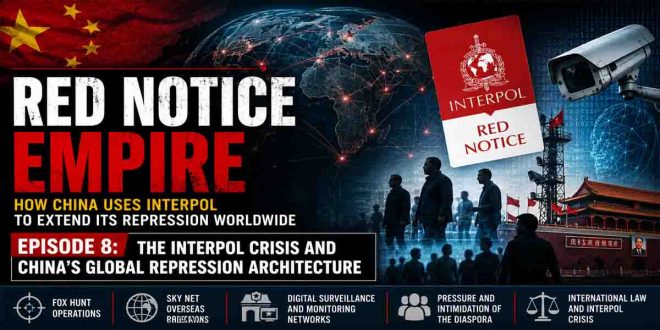
From Fox Hunt to INTERPOL, from Overseas Police Stations to digital surveillance networks, how does this alleged global pressure system operate? Throughout the previous seven parts of this series, we examined from different perspectives the allegations surrounding China’s use of international security and judicial cooperation mechanisms. From the functioning of the INTERPOL Red Notice system and China’s role within this framework, to the case of former INTERPOL President Meng Hongwei, from Red Notice applications allegedly carrying political motivations to cases involving Uyghurs, Falun Gong practitioners, dissidents, and business figures, we explored a broad framework that also included appeal procedures before the INTERPOL Commission for the Control of INTERPOL’s Files (CCF).
Each chapter examined a different dimension of this complex structure through the lens of international law, court decisions, human rights reports, and investigative journalism. However, when these issues are examined individually, only part of the broader picture becomes visible. The more significant question is whether Fox Hunt, Sky Net, INTERPOL Red Notices, overseas police stations, digital surveillance technologies, monitoring activities targeting diaspora communities, alleged pressure placed through family members, and economic pressure mechanisms should be understood not as separate practices, but as interconnected components of a wider strategic approach.
International investigations and various legal proceedings published in recent years have highlighted allegations that these tools have, in certain cases, been used simultaneously or in ways that complement each other.
One of the notable investigations in this context is the China Targets investigation conducted by the International Consortium of Investigative Journalists (ICIJ). Based on court records, official documents, and testimonies gathered by journalists from multiple countries, the investigation examines alleged transnational pressure mechanisms used against certain individuals and groups outside China.
The cases documented in the investigation provide significant examples of how many of the elements discussed throughout this series may operate in connection with each other on an international scale.
For this reason, the final chapter of the series does not focus on a single Red Notice case or an isolated incident. Instead, it aims to evaluate all previously examined elements within a broader framework.
The central question is no longer limited to whether a particular Red Notice complies with legal standards. From a wider perspective, the debate concerns how international law enforcement cooperation mechanisms can be protected against allegations of transnational repression, whether existing oversight systems are sufficient, and how international law should respond to this emerging security paradigm.
In this final chapter of “The Red Notice Empire,” the entire mechanism — extending from Fox Hunt and Sky Net to INTERPOL, overseas police structures, digital surveillance technologies, and allegations of psychological and economic pressure against diaspora communities — will be examined through a comprehensive analytical framework.
The aim is to bring together elements that have previously been discussed separately and provide a broader assessment of what has increasingly been described by international observers as China’s global pressure architecture.
China’s Global Pressure Architecture: Mapping the Mechanism
The cases examined throughout the previous seven chapters point to numerous practices that may initially appear unrelated. However, when international human rights reports, investigative journalism, court records, and official documents are evaluated together, a broader pattern emerges: these practices may function as interconnected tools serving specific strategic objectives.
For this reason, many experts analyze these developments not merely as individual operations, but within the wider framework of “transnational repression” — a concept used to describe efforts by states to influence, monitor, intimidate, or pressure individuals beyond their borders.
At the center of this architecture is the Chinese Communist Party’s (CCP) approach to national security and political stability. Various state institutions, particularly the Ministry of Public Security (MPS), play a role in implementing China’s security policies.
In recent years, numerous international investigations have raised allegations that these institutions have attempted to reach individuals abroad through various programs and mechanisms.
One of the first elements of this structure is Fox Hunt, a campaign officially described by Chinese authorities as an effort to combat corruption and return fugitives accused of financial crimes.
While Chinese authorities emphasize anti-corruption objectives, human rights organizations and legal cases have raised allegations that some operations have also targeted political opponents, activists, and critics of the Chinese government.
A second major component complementing Fox Hunt is the Sky Net (Skynet) program. Unlike a narrow extradition mechanism, Sky Net has been described as a broader strategy involving financial tracking, international cooperation, digital analysis, and coordination between multiple state institutions.
According to critics, this approach means that pressure on targeted individuals may extend beyond formal legal procedures and involve multiple forms of influence.
INTERPOL occupies a distinct position within this broader picture. INTERPOL is an independent international organization whose primary purpose is to facilitate cooperation between countries in combating crime.
However, as examined in previous chapters, allegations have emerged that certain Red Notice and Diffusion requests have been used for political purposes. Some applications have been challenged before INTERPOL’s Commission for the Control of INTERPOL’s Files (CCF) and, in certain cases, removed or cancelled.
These developments have intensified international discussions about the risk of abuse within global law enforcement cooperation mechanisms.
Another issue attracting significant attention in recent years concerns structures identified in several countries and commonly referred to as “Overseas Police Stations.”
While China states that these offices provide administrative services to Chinese citizens abroad, some governments, lawmakers, and human rights organizations have launched investigations into allegations that certain locations may have been used to pressure diaspora communities or conduct unofficial security activities.
These alleged mechanisms have also been supported by expanding digital surveillance capabilities.
Monitoring activities involving communication applications, social media platforms, online tracking systems, and big data analysis have become a recurring concern in international reports, particularly regarding Chinese dissidents abroad, Uyghurs, Tibetans, Hong Kong democracy activists, and other diaspora communities.
Beyond physical monitoring, alleged psychological pressure methods have also attracted attention.
International investigations have documented cases in which individuals abroad were allegedly pressured through actions targeting family members inside China, including questioning relatives, restricting travel rights, interfering with property matters, or applying economic pressure.
According to these reports, such methods may be intended to encourage individuals to return to China or abandon their activities abroad.
The overall picture suggests that these practices cannot be fully understood when examined separately.
Fox Hunt, Sky Net, INTERPOL applications, overseas police structures, digital surveillance, diaspora monitoring, family-based pressure tactics, and economic pressure allegations together form the core elements of the international debate surrounding China’s alleged transnational repression architecture.
One of the most comprehensive international investigations examining how these mechanisms allegedly operate in practice is the China Targets investigation published by the International Consortium of Investigative Journalists (ICIJ).
In the next section, the findings of this investigation will be examined in detail to better understand how this alleged structure functions on the ground.
What Do International Investigations Reveal? How ICIJ’s “China Targets” Investigation Completes the Bigger Picture
The findings examined throughout the previous seven chapters of “The Red Notice Empire” were evaluated through the framework of international legal documents, court decisions, human rights reports, and expert assessments. However, major investigative journalism projects published in recent years have also demonstrated that many of the mechanisms discussed in these cases are receiving increasing international scrutiny.
One of the most significant investigations in this field is the China Targets investigation coordinated by the International Consortium of Investigative Journalists (ICIJ). Conducted with the participation of journalists from various countries, the investigation brings together court records, official documents, witness accounts, and investigations conducted in different jurisdictions to examine alleged transnational pressure mechanisms targeting individuals and groups outside China.
One of the most notable aspects of the investigation is that practices previously viewed as separate from one another appear together within the same cases. The examined files include examples suggesting that INTERPOL Red Notices, diplomatic initiatives, alleged digital surveillance, psychological pressure through family members, economic threats, and persuasion efforts conducted through third parties may, in some cases, function as interconnected tools.
In this respect, China Targets is regarded as one of the most comprehensive investigations examining concrete examples of what international literature increasingly describes as “transnational repression.”
One of the most notable cases examined in the investigation concerns a Chinese businessman identified as H. According to the case materials, the businessman, who was subject to an INTERPOL Red Notice, was detained in France and later claimed that he faced significant pressure to return to China.
Court records and documents reviewed in the investigation indicate that the process allegedly extended beyond international judicial cooperation mechanisms. It was claimed that pressure was also applied through family members, personal networks, and various intermediaries.
At this point, the case of Chinese entrepreneur Jack Ma became relevant for a different reason. According to documents obtained by ICIJ, Jack Ma was allegedly approached by Chinese authorities as an intermediary in an effort to persuade the businessman to return to China.
This allegation attracted significant international media attention. However, the main focus of the discussion was not Jack Ma himself, but the broader question of whether state mechanisms can involve different actors in attempts to reach individuals considered targets.
This case represents one of the examples supporting a central argument examined throughout this series: in alleged cases of transnational repression, the tools involved often do not operate independently. INTERPOL requests, diplomatic contacts, pressure allegedly applied through family members, economic leverage, and informal mediation efforts may become interconnected elements working toward the same objective.
In other words, the issue is not limited to whether a single Red Notice has been issued. The broader concern is that international investigations have identified allegations that legal, diplomatic, economic, and psychological tools may be used simultaneously in certain cases.
This is precisely why the ICIJ China Targets investigation has attracted attention. The investigation provides extensive examples of how mechanisms examined separately throughout this series may, in practice, become interconnected parts of a broader strategy.
Therefore, China Targets should not be viewed as a single document that independently proves every element discussed in “The Red Notice Empire.” Rather, it should be understood as an important independent source that expands the debate through investigative journalism, court records, and multiple testimonies.
The Common Pattern Revealed by the ICIJ Investigation: How Does an Alleged Transnational Pressure Mechanism Operate?
Each topic examined throughout “The Red Notice Empire” represents a different component of a wider mechanism. One of the cases analyzed in the ICIJ China Targets investigation provides an important example of how these different elements may come together in practice.
According to the investigation, the process begins with the identification of a target individual. After a person is associated with allegations of economic crimes, corruption, or other offenses, domestic investigations may begin. In some cases, these processes are then expanded internationally through mechanisms such as INTERPOL cooperation.
Through tools such as an INTERPOL Red Notice or Diffusion notice, authorities seek to locate individuals abroad and initiate legal procedures.
However, court records and testimonies examined by ICIJ indicate that, in some cases, the process may extend beyond formal judicial cooperation mechanisms.
According to allegations documented in the investigation, individuals abroad may face sustained communication efforts and attempts at persuasion through various channels. These efforts may involve official authorities or may be conducted through personal contacts, family members, or business networks.
One of the most significant findings highlighted by the investigation concerns allegations of psychological pressure applied through family members.
In several cases examined, there are allegations that relatives living in China were questioned, summoned for meetings with authorities, subjected to travel restrictions, or faced administrative difficulties.
Human rights organizations have also documented concerns that similar methods may be used to indirectly pressure activists, dissidents, and other individuals living abroad.
Economic pressure allegations represent another important element of the investigation.
According to accounts included in court documents and investigative reports, some cases involved alleged attempts to influence individuals through property-related actions, business activities, commercial relationships, or financial uncertainty.
As a result, legal procedures may become part of a broader multi-layered process involving economic pressure and psychological influence.
Another development that attracted international attention in the ICIJ investigation was the involvement of Chinese technology entrepreneur Jack Ma.
According to the investigation, Jack Ma was allegedly asked to act as an intermediary to persuade the targeted individual to return to China.
This allegation intensified discussions about whether state mechanisms may involve not only official channels but also influential business figures or public personalities who may have access to targeted individuals.
Another important issue raised by the investigation is the concept of “voluntary return.”
According to the cases examined, official narratives may present individuals as returning to China by their own choice. However, allegations suggest that such decisions may occur after prolonged legal uncertainty, pressure involving family members, psychological stress, and economic risks.
This has led to broader international discussions about whether such returns genuinely reflect free and independent choices.
For this reason, the picture presented by ICIJ extends beyond a simple debate over INTERPOL Red Notices.
The cases examined suggest that, in certain situations, international law enforcement mechanisms may be considered alongside diplomatic initiatives, alleged psychological pressure, family-related influence, economic tools, and third-party mediation efforts.
In other words, the objective alleged in these cases is not only locating an individual, but using multiple forms of influence simultaneously to encourage or compel their return.
When the legal framework discussed in the earlier chapters of this series is examined together with the concrete cases presented by ICIJ, it becomes clear that the debate over transnational repression cannot be explained through a single institution or a single practice.
The central issue is understanding how different institutions, methods, and actors may come together in pursuit of a common strategic objective.
This broader perspective also explains why all the elements examined throughout “The Red Notice Empire” must be evaluated together rather than separately.
Assessment from the Perspective of International Law: The Delicate Balance Between Security and Fundamental Rights
The cases examined throughout “The Red Notice Empire” raise questions that go beyond allegations concerning China or debates surrounding the INTERPOL system. They also bring back into focus a fundamental issue in international law: how basic legal principles can be protected in an era of expanding cross-border security policies.
Today, the debate is not limited only to a state’s authority to combat crime. It is also directly connected to how that authority is exercised within the boundaries established by international human rights law.
One of the central principles in this discussion is the principle of non-refoulement.
Recognized as a cornerstone of refugee law and international human rights law, non-refoulement prohibits the forced return of individuals to countries where they may face risks of torture, ill-treatment, arbitrary detention, or politically motivated prosecution.
For this reason, courts in many countries do not examine only whether an extradition request is formally lawful. They also assess the potential human rights consequences an individual may face if transferred.
This assessment becomes particularly significant in cases where political motivations are alleged.
Another important issue is the political offense exception.
Long recognized within international extradition law, this principle reflects the legal tradition that individuals should not be surrendered solely because of accusations that are fundamentally political in nature.
Therefore, many states evaluating extradition requests consider not only the name of the alleged offense but also the circumstances surrounding the case, the nature of the evidence, the independence of the judicial process, and whether political motives may exist behind the request.
Similarly, the right to a fair trial remains one of the essential guarantees of international law.
International instruments, including the European Convention on Human Rights, establish that every person has the right to a hearing before an independent and impartial tribunal.
Where there are substantial indications that these guarantees may be seriously violated in the requesting country, courts may reject extradition requests or suspend proceedings.
One of the institutions at the center of these discussions is INTERPOL.
Article 3 of the INTERPOL Constitution explicitly prohibits the organization from undertaking any intervention or activities of a political, military, religious, or racial character.
This provision is considered one of the organization’s fundamental safeguards designed to ensure that international police cooperation remains separate from political disputes.
Therefore, when serious concerns arise that a Red Notice or Diffusion may have been issued for political purposes, INTERPOL’s internal review mechanisms may become involved.
A key institution in this process is the Commission for the Control of INTERPOL’s Files (CCF).
As examined in previous chapters of this series, the CCF serves as an independent oversight mechanism through which individuals may challenge information contained in INTERPOL’s databases.
The Commission reviews cases not only from a procedural perspective but also according to the INTERPOL Constitution, INTERPOL’s Rules on the Processing of Data, and international human rights standards.
The removal of certain politically motivated notices from INTERPOL databases in recent years demonstrates the importance of this mechanism within the broader framework of international law.
National and regional courts have also taken an increasingly significant role in this process.
Particularly in Europe, courts evaluating extradition requests do not rely solely on diplomatic assurances. They conduct detailed assessments concerning the prohibition of torture, the right to a fair trial, personal liberty and security, and the principle of non-refoulement.
The established case law of the European Court of Human Rights and decisions of various national supreme courts demonstrate the need to maintain a careful balance between international police cooperation and the protection of fundamental rights.
These developments have also created a broader debate within international law.
How can a balance be achieved between a state’s right to combat cross-border crime and the protection of individual rights and freedoms?
International police cooperation remains essential in addressing global security challenges. However, allegations that such mechanisms may be used for political purposes demonstrate the need for stronger oversight and accountability systems.
One of the central conclusions of “The Red Notice Empire” series is precisely this point.
The issue is not questioning the necessity of INTERPOL or international judicial cooperation. The real challenge is strengthening transparency, accountability, and independent review mechanisms to ensure that these systems operate according to their original purpose.
From the perspective of international law, security and freedom are not competing values. They are two fundamental principles that must be protected simultaneously.
What Comes Next for INTERPOL? Reform Debates and Future Recommendations
The cases examined throughout “The Red Notice Empire” do not primarily question INTERPOL’s critical role in combating international crime. Instead, they raise a broader question: how effective are existing safeguards in preventing potential misuse of the system?
Recent discussions among international legal experts, human rights organizations, and investigative journalists increasingly point toward the same conclusion: a stronger balance must be established between effective international police cooperation and the protection of fundamental rights.
One of the most frequently discussed reform proposals concerns increasing transparency.
Many of INTERPOL’s review procedures currently operate under confidentiality principles. While confidentiality may serve important purposes related to investigation security, greater access to statistical information and institutional explanations regarding how Red Notices and Diffusions are approved, rejected, or removed could strengthen public confidence in the system.
A second major area of reform involves strengthening independent oversight mechanisms.
The Commission for the Control of INTERPOL’s Files (CCF) provides an important safeguard by reviewing individual challenges. However, many legal experts and civil society organizations argue that the Commission should receive additional resources, that review procedures should become faster, and that applicants should have more effective access to procedural information.
Such reforms could allow alleged rights violations to be assessed more quickly while improving confidence in INTERPOL’s procedures.
A third reform area concerns faster review of applications.
Individuals subject to Red Notices or Diffusions may face years of travel restrictions, difficulties accessing financial services, or serious professional limitations while waiting for their challenges to be resolved.
For this reason, proposals have been made to accelerate preliminary assessments, particularly in cases involving allegations of political motivation, and to prioritize files where there is a higher risk of human rights violations.
Another proposal increasingly discussed in international legal circles is strengthening political risk assessments.
Under this approach, the formal nature of criminal allegations should not be the only consideration. The requesting country’s human rights record, international assessments concerning judicial independence, previous CCF decisions, and international court jurisprudence should also form part of the review process.
Such an approach could contribute to a more effective implementation of INTERPOL’s principle of political neutrality.
Another important dimension of reform concerns the responsibilities of member states.
INTERPOL is an international cooperation organization that relies heavily on information provided by its member countries. Therefore, the integrity of the system depends not only on INTERPOL’s internal oversight but also on member states acting in accordance with principles of good faith, honesty, and international legal obligations.
Legal experts emphasize that politically motivated or human rights-incompatible requests do not only affect individuals. They also undermine confidence in the entire international police cooperation framework.
Technological developments have added another dimension to reform discussions.
As digital information sharing, biometric data, artificial intelligence-based analysis systems, and cross-border security cooperation continue to expand, the need for new international standards ensuring that these technologies respect fundamental rights is becoming increasingly important.
The INTERPOL system of the future will need to be not only faster and more effective, but also more transparent, accountable, and resilient in protecting human rights.
At this stage, the debate is no longer limited to a single country or a single case.
A strong global law enforcement cooperation system remains essential in addressing transnational crime, terrorism, organized criminal networks, human trafficking, and cybercrime.
However, allegations of political misuse, together with court decisions and investigative reports examining these concerns, demonstrate that international oversight mechanisms must continue to evolve.
The most important question for the future is therefore not whether INTERPOL should exist, but how it can adapt to a changing global security environment while maintaining both effective crime prevention and the highest possible protection of fundamental rights.
The answer will influence not only the future of INTERPOL, but also the broader direction of international law and the global justice system.
Beyond a Series of Articles: A Questioning of the Global Legal Order
Throughout eight chapters, “The Red Notice Empire” examined the functioning of the INTERPOL Red Notice system, allegations concerning China’s use of this mechanism, the Fox Hunt and Sky Net operations, debates surrounding overseas police structures, digital surveillance technologies, alleged pressure on diaspora communities, claims of psychological pressure through family members, and the broader phenomenon of transnational repression increasingly discussed within international law.
Each chapter sought to examine a different dimension of the same fundamental question through the lens of international court decisions, human rights reports, academic studies, and investigative journalism.
One of the most important conclusions reached throughout this investigation is that focusing only on individual cases may cause the broader picture to be overlooked.
A Red Notice, by itself, may be viewed simply as a component of international police cooperation. An extradition request may be considered merely a legal process between two states. Allegations of digital monitoring or pressure placed on family members may also appear to be isolated incidents.
However, when these elements appear within the same case, during the same process, and toward the same objective, the resulting picture helps explain why the concept of transnational repression has become an increasingly significant subject of international debate.
Although the examples examined in this series focus on allegations concerning China, the legal questions they raise are universal in nature.
How can the neutrality of international police cooperation mechanisms be protected?
How can a balance be maintained between states’ legitimate authority to combat crime and individuals’ fundamental rights and freedoms?
How can refugee law, the principle of non-refoulement, the right to a fair trial, and the principle of political neutrality be strengthened in an era of expanding global security policies?
These questions are not directed only at a single country. They concern the international legal order as a whole.
INTERPOL remains an essential platform for international cooperation against organized crime, terrorism, human trafficking, child exploitation, cybercrime, and other serious offenses.
This reality has never been questioned throughout this series.
On the contrary, the investigation has emphasized that protecting the credibility of such an important institution requires continuous improvement of oversight mechanisms designed to prevent politically motivated applications.
Because a strong INTERPOL system and strong human rights safeguards are not competing objectives. They are two fundamental elements that must support one another.
When the International Consortium of Investigative Journalists’ (ICIJ) China Targets investigation, human rights organizations’ reports, legal proceedings in different countries, and decisions of the INTERPOL Commission for the Control of INTERPOL’s Files (CCF) are examined together, it becomes clear that the international community has increasingly focused on these debates in recent years.
However, as global security policies continue to evolve rapidly, calls for stronger oversight mechanisms are also increasing.
“The Red Notice Empire” is not merely a series examining alleged practices involving China and the INTERPOL system.
It is also a broader investigative examination of the new challenges facing international law, human rights protections, and global security mechanisms through research findings, court decisions, and publicly documented cases.
Therefore, the question that should be asked at the conclusion of this series is no longer simply:
“What did China do?”
The deeper question is:
Is the international legal system strong, transparent, and accountable enough to protect fundamental rights and freedoms in the face of allegations of transnational repression?
The answer to this question will shape not only the future of INTERPOL, but also the credibility of the international justice system, the legitimacy of legal cooperation between states, and the protection of fundamental rights for millions of people around the world.
Perhaps the most important conclusion of this series is precisely this:
The world does not have to choose between a strong international security system and a strong human rights framework.
The real challenge is building a global order based on the rule of law — one that can protect both at the same time through transparency, accountability, and effective safeguards.
Conclusion: A Critical Question for the Future of Global Justice
The series “The Red Notice Empire” does not focus only on allegations involving specific individuals or groups.
It examines a broader discussion concerning how international law, human rights standards, and global justice mechanisms are used and protected.
As the influence of individual states within international institutions increases, questions may arise regarding the neutrality, independence, and credibility of those institutions.
The fundamental purpose of global security organizations such as INTERPOL is to combat crime independently of political interests and to uphold the rule of law.
However, allegations that any state may attempt to use these mechanisms in pursuit of political objectives highlight the need for stronger international oversight, transparency, and accountability.
The central issue today is not only individual cases or specific individuals.
The deeper question is whether the international legal order can operate equally for everyone, regardless of the influence or power of individual states.
Because when justice mechanisms lose public trust, the damage extends beyond those directly affected. It weakens confidence in the entire global legal system.
For this reason, international institutions must continue working toward structures that remain independent from political pressure, transparent in their procedures, accountable in their decisions, and committed to universal legal principles.
Red Notices may serve as powerful tools in cross-border security cooperation.
However, they are also mechanisms that require continuous oversight to ensure that human rights and fundamental freedoms remain protected
East Turkestan Bulletin News Agency / NEWS CENTER
 References
 References
- INTERPOL – Red Notices and Diffusions: Official Information
International Criminal Police Organization (INTERPOL) explains the purpose, legal framework and review mechanisms of Red Notices and Diffusions.
https://www.interpol.int/How-we-work/Notices/Red-Notices - INTERPOL – Commission for the Control of INTERPOL’s Files (CCF)
The CCF is the independent body responsible for reviewing challenges concerning information processed through INTERPOL channels.
https://www.interpol.int/Who-we-are/Commission-for-the-Control-of-INTERPOL-s-Files-CCF - Human Rights Watch – China: Events of Recent Years
Human Rights Watch reports on human rights developments in China, including issues related to Xinjiang, surveillance and transnational repression.
https://www.hrw.org/asia/china - Amnesty International – China: Human Rights Reports
Amnesty International documents human rights concerns in China, including restrictions on freedoms and treatment of ethnic minorities.
https://www.amnesty.org/en/location/asia-and-the-pacific/east-asia-the-pacific/china/ - United Nations Office of the High Commissioner for Human Rights (OHCHR) – Assessment of Human Rights Concerns in the Xinjiang Uyghur Autonomous Region
The UN human rights office published an assessment concerning allegations of serious human rights violations in Xinjiang.
https://www.ohchr.org/en/documents/country-reports/ohchr-assessment-human-rights-concerns-xinjiang-uyghur-autonomous-region - U.S. Congressional-Executive Commission on China (CECC) – Annual Reports
CECC publishes research and assessments on human rights and rule-of-law issues in China.
https://www.cecc.gov/publications/annual-reports - U.S. Department of State – Country Reports on Human Rights Practices: China
Annual reports covering human rights conditions and government practices in China.
https://www.state.gov/reports-bureau-of-democracy-human-rights-and-labor/ - Safeguard Defenders – Transnational Repression Reports
Research organization documenting cases of alleged overseas pressure, intimidation and coercion linked to Chinese authorities.
https://safeguarddefenders.com/
Further Reading
 Further Reading
- Freedom House – Beijing’s Global Reach: China’s Transnational Repression
A research report examining allegations of China’s efforts to influence, pressure and monitor individuals beyond its borders.
https://freedomhouse.org/report/transnational-repression - The International Consortium of Investigative Journalists (ICIJ) – China Cables
An investigation examining leaked documents related to security policies and mass surveillance systems in Xinjiang.
https://www.icij.org/investigations/china-cables/ - European Parliament – China and Human Rights Studies
European Parliament research publications addressing EU-China relations, human rights and international security concerns.
https://www.europarl.europa.eu/thinktank/ - Council on Foreign Relations (CFR) – China’s Foreign Policy and Global Influence
Research and analysis on China’s international strategies and global influence.
https://www.cfr.org/china - Brookings Institution – China Research Program
Policy analysis covering China’s governance, international relations and security issues.
https://www.brookings.edu/topic/china/ - Chatham House – China and International Order Research
Independent research on China’s global role and challenges facing international institutions.
https://www.chathamhouse.org/topics/china - The International Bar Association – Rule of Law Resources
Research and discussions on international law, judicial independence and legal standards.
https://www.ibanet.org/ - United Nations Human Rights – Universal Human Rights Framework
Background resources on international human rights standards and monitoring mechanisms.
https://www.ohchr.org/


