 Doğu Türkistan Haberleri – Son Dakika – Uygur Haber Ajansı Doğu Türkistan Haberleri ve Çin haberleri; toplama kampları, istihbarat savaşları, İnterpol suiistimalleri, sınır ötesi Uygur avı ve küresel PSC tehdidi analizleri.

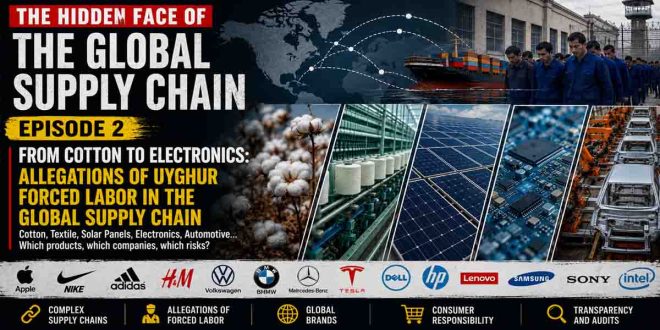
Tracing the Production Network from East Turkistan to Global Markets: In the first installment of this series, we examined allegations that a system linking so-called re-education camps and labor transfer programs has been established in East Turkistan. Chinese authorities describe these initiatives as part of broader policies aimed at creating employment opportunities, providing vocational education, and reducing poverty. In contrast, United Nations experts, human rights organizations, academic researchers, and numerous open-source investigations have raised concerns that elements of these programs may be inconsistent with international labor standards.
The debate, however, extends far beyond the borders of East Turkistan. Today, allegations that raw materials and intermediate products originating from the region are incorporated into global supply chains—from textiles and apparel to solar panels, automobiles, and consumer electronics—have become one of the most closely scrutinized human rights issues in international trade.
As a result, the issue is no longer viewed solely through the lens of China’s domestic policies. It has also become a major topic in discussions surrounding global supply-chain transparency, corporate accountability, responsible sourcing, and international trade regulations.
Why Is East Turkistan a Key Hub in Global Manufacturing?
Beyond its strategic importance to Beijing, East Turkistan has developed into one of China’s most significant industrial and raw-material production centers.
The region is a major producer of:
- cotton,
- polysilicon,
- coal and energy resources,
- aluminum,
- tomato products,
- textile yarn,
- industrial chemicals, and
- a range of minerals used in electronic components and advanced manufacturing.
These industries make East Turkistan an important link in global manufacturing networks, supplying raw materials and industrial inputs that move through multiple tiers of international supply chains before reaching consumers worldwide.
In recent years, a growing number of reports published by international organizations, research institutions, and human rights groups have examined whether this industrial capacity is connected to allegations of state-sponsored forced labor programs. The findings remain the subject of ongoing international debate, with Chinese authorities consistently rejecting such allegations.
Cotton: The Starting Point of the Debate
East Turkistan is widely recognized as one of the world’s largest cotton-producing regions.
According to international research, a significant share of China’s cotton is produced in the region before entering domestic and international manufacturing networks.
Once harvested, the cotton is processed into:
- yarn,
- fabric,
- ready-made garments, and
- home textiles,
before becoming part of global supply chains that serve markets across Southeast Asia, Europe, North America, the Middle East, and many other regions.
Several human rights organizations, academic institutions, and independent research centers have alleged that some workers involved in cotton production may have participated in state-sponsored labor transfer programs that raise concerns under international labor standards.
The Chinese government rejects these allegations, maintaining that all employment and vocational training programs are voluntary and intended to improve economic opportunities and reduce poverty.
The Textile Industry
Cotton represents only the first stage of a far more complex manufacturing process.
The greater challenge begins once raw cotton enters an extensive network of suppliers before reaching global consumer brands.
A single garment may pass through multiple stages of production:
Cotton Producer → Yarn Mill → Textile Factory → Dyeing Facility → Garment Manufacturer → Exporter → Global Brand → Retailer
Because of this multi-tiered production system, tracing the exact origin of the cotton used in a finished product can be extremely difficult.
For this reason, many human rights organizations argue that greater transparency and traceability throughout global supply chains are essential to identifying and mitigating potential labor-rights risks.
The Solar Panel Industry
In recent years, the solar energy sector has become another major focus of international scrutiny.
China is the world’s leading producer of polysilicon, one of the key raw materials used in modern photovoltaic solar panels.
International studies indicate that East Turkistan accounts for a significant share of global polysilicon production.
Polysilicon is a critical component in the manufacture of:
- solar panels,
- semiconductors, and
- electronic devices.
As global demand for renewable energy technologies continues to grow, questions surrounding the sourcing of polysilicon from East Turkistan have become an increasingly prominent issue in international supply-chain discussions.
The Electronics Industry
The electronics sector presents an even more complex supply-chain structure.
Products such as:
- smartphones,
- computers,
- tablets,
- data servers,
- automotive electronics, and
- telecommunications equipment
are assembled using thousands of components supplied by manufacturers located across multiple countries.
Several international reports have suggested that certain producers of electronic components may be linked to government labor transfer programs operating in East Turkistan.
However, these reports generally do not conclude that all multinational technology companies manufacturing final consumer products directly benefit from such programs.
Many companies have acknowledged that monitoring lower-tier suppliers beyond their direct business partners remains one of the greatest challenges in modern global supply-chain management.
The Automotive Industry
The rapid expansion of electric vehicles has brought the automotive industry into the broader discussion surrounding supply-chain due diligence.
Modern vehicles rely on globally sourced materials and components, including:
- aluminum,
- electronic circuit boards,
- wiring systems,
- battery components,
- solar energy technologies, and
- specialized metal alloys.
These materials often pass through multiple suppliers and countries before reaching vehicle manufacturers.
In response to growing regulatory requirements and investor scrutiny, many automotive companies have strengthened their supplier-review processes in recent years.
While some manufacturers have introduced enhanced auditing and traceability mechanisms, others have announced that they have suspended or terminated relationships with suppliers identified as presenting elevated human-rights risks.
Companies Named in Public Reports and Growing Consumer Pressure
The issue of supply-chain transparency has placed numerous multinational corporations under increased public scrutiny.
Over the past several years, international research institutions, human rights organizations, and academic studies have examined whether supply chains linked to East Turkistan may extend into the production networks of globally recognized brands.
These investigations generally do not focus on companies’ own manufacturing facilities. Instead, they examine upstream suppliers, subcontractors, raw-material producers, and logistics networks that form part of today’s highly interconnected global supply chains.
Because modern manufacturing often involves multiple countries and several layers of suppliers, determining:
- where raw materials originate,
- where they are processed,
- which countries they pass through, and
- which subcontractors are involved
can be extremely challenging.
For this reason, many human rights organizations argue that companies should extend their due diligence beyond direct suppliers and strengthen oversight throughout every tier of their supply chains.
Global Fashion Brands and the Cotton Debate
The textile industry has remained at the center of international discussions surrounding supply chains linked to East Turkistan.
Most research has focused on the movement of cotton through yarn production, textile manufacturing, garment assembly, and international distribution.
Among the multinational companies whose supply chains have been discussed in publicly available reports at various times are:
- Nike
- Adidas
- H&M
Each of these companies has publicly stated that it prohibits forced labor, maintains human rights policies, and requires suppliers to comply with corporate standards and international labor principles.
However, several human rights organizations argue that verifying labor conditions independently remains particularly difficult in environments where unrestricted third-party access is limited. As a result, they continue to call for greater transparency, stronger traceability systems, and more rigorous supply-chain due diligence.
Technology Companies and the Invisible Supply Chain
The global electronics industry presents one of the most complex supply-chain structures in modern manufacturing.
A single smartphone or laptop may contain hundreds of individual components sourced from dozens of suppliers operating across multiple countries.
Consequently, several international reports have examined the supply-chain policies of major technology companies, including:
- Apple
- Dell Technologies
- HP Inc.
- Lenovo
- Samsung Electronics
- Sony
- Intel
The central question raised in these discussions is generally not whether these companies directly employ forced labor.
Instead, researchers and policymakers have increasingly focused on whether multinational corporations can effectively identify and monitor the origin of raw materials and components supplied through multiple tiers of manufacturing.
As supply chains become more fragmented and geographically dispersed, ensuring full traceability remains one of the industry’s greatest challenges.
The Automotive Industry and Emerging Supply-Chain Risks
The transition to electric vehicles has expanded the debate beyond textiles and consumer electronics.
Modern automobiles rely on globally sourced materials and technologies, including:
- electronic control systems,
- battery components,
- aluminum products,
- solar-energy-related technologies, and
- advanced industrial materials.
Many of these components pass through numerous suppliers before reaching vehicle manufacturers.
Several publicly available reports have discussed the supply chains of companies such as:
- Volkswagen Group
- BMW Group
- Mercedes-Benz Group
- Tesla
In response to increasing regulatory requirements and public scrutiny, many automotive manufacturers have strengthened their human rights due diligence procedures, expanded supplier monitoring programs, and introduced additional traceability measures.
Do Consumer Boycotts Make a Difference?
Growing public awareness has encouraged consumers around the world to question how everyday products are manufactured.
Public campaigns have taken many forms, including:
- consumer boycotts,
- social media advocacy,
- ethical purchasing initiatives,
- corporate transparency campaigns, and
- shareholder and investor engagement.
Experts remain divided over how much influence individual consumer decisions have on multinational corporations.
However, many analysts agree that sustained public attention can encourage companies to publish more detailed human rights reports, improve supplier oversight, strengthen compliance programs, and reassess relationships with suppliers operating in high-risk regions.
What Can Consumers Do?
Specialists in corporate governance and responsible sourcing suggest that consumers can contribute not only through purchasing decisions but also by seeking greater transparency from companies.
Consumers are encouraged to:
- review corporate human rights and sustainability policies;
- examine supply-chain transparency reports;
- consult independent audits and publicly available assessments where available;
- seek information about product origin and sourcing practices; and
- support initiatives promoting stronger corporate accountability and responsible supply-chain management.
While consumers rarely have complete visibility into complex international supply chains, greater public awareness and informed purchasing decisions continue to play an increasingly important role in shaping corporate transparency and responsible sourcing practices worldwide.
Conclusion: Responsibility Extends Beyond Manufacturers
Global supply chains are no longer monitored solely by governments, regulators, and multinational corporations. Consumers, investors, civil society organizations, and policymakers are increasingly paying attention to how products are sourced and manufactured.
The journey of a cotton T-shirt, a solar panel, or an electronic device—from raw materials and manufacturing facilities to retail shelves—has become one of the least visible yet most closely scrutinized aspects of the modern global economy.
As a result, the central question is no longer simply:
“Where was this product made?”
Increasingly, consumers, regulators, and investors are asking:
“Under what conditions was this product made?”
How Have Companies Responded?
Many multinational corporations referenced in publicly available reports have stated that they:
- maintain zero-tolerance policies toward forced labor;
- conduct regular supplier audits and compliance reviews;
- require suppliers to follow internationally recognized labor and human rights standards; and
- reassess or terminate supplier relationships when significant risks or violations are identified.
At the same time, several human rights organizations argue that independent verification remains particularly challenging in East Turkistan because of limitations on unrestricted third-party access. According to these organizations, conventional social compliance audits alone may not always be sufficient to identify or assess potential labor-rights risks in the region.
The Greatest Challenge: Supply-Chain Traceability
One of the defining characteristics of today’s global economy is the complexity of international supply chains.
A single product may pass through dozens of countries and hundreds of suppliers before reaching the final consumer.
Consequently, it is not always possible to determine with certainty where:
- a kilogram of cotton,
- an electronic chip,
- a solar cell, or
- an automotive component
was originally produced or processed.
For this reason, governments, corporations, and international organizations have increasingly focused on:
- supply-chain mapping,
- digital traceability technologies,
- human rights due diligence,
- enhanced supplier disclosure, and
- independent verification mechanisms.
These tools are becoming central elements of international trade policy, corporate governance, and responsible sourcing strategies.
Final Assessment
Allegations of forced labor in East Turkistan have evolved beyond a human rights issue into a broader discussion involving global trade, international investment, corporate governance, environmental, social and governance (ESG) standards, and international law.
On one side, Chinese authorities maintain that employment and vocational training programs are designed to promote economic development, poverty reduction, and social stability.
On the other, United Nations experts, human rights organizations, academic researchers, and independent investigations continue to raise concerns about the potential risk of forced labor within certain labor transfer programs and supply chains.
What is increasingly clear, however, is that consumers, governments, investors, and multinational corporations are paying closer attention than ever before to the origins of the products they buy, manufacture, import, and sell.
As global expectations for transparency continue to grow, supply-chain accountability has become one of the defining challenges facing international commerce in the twenty-first century.
 15
15
East Turkestan Bulletin News Agency / NEWS CENTER
References & Further Reading
The following reports, official documents, academic studies, and corporate publications provide additional context on allegations concerning forced labor, global supply chains, corporate due diligence, and human rights issues related to East Turkistan (Xinjiang).
OFFICIAL REPORTS & INTERNATIONAL SOURCES
1. Office of the United Nations High Commissioner for Human Rights (OHCHR)
Assessment of Human Rights Concerns in the Xinjiang Uyghur Autonomous Region, People’s Republic of China (2022)
The UN Human Rights Office’s assessment of the human rights situation in Xinjiang, examining allegations concerning detention systems, labor programs, and broader human rights issues.
2. International Labour Organization (ILO)
Forced Labour Convention, 1930 (No. 29)
The ILO’s internationally recognized definition of forced labor and the legal standards governing labor rights.
https://www.ilo.org/dyn/normlex/en/f?p=NORMLEXPUB:12100:0::NO::P12100_ILO_CODE:C029
3. U.S. Department of Homeland Security (DHS)
Uyghur Forced Labor Prevention Act (UFLPA)
Official information, implementation guidance, and enforcement resources related to the UFLPA.
SUPPLY CHAIN & INDUSTRY REPORTS
4. Sheffield Hallam University – Helena Kennedy Centre for International Justice
Laundering Cotton: How Xinjiang Cotton Is Obscured in International Supply Chains
An in-depth study examining how cotton originating from Xinjiang may enter global textile supply chains.
5. Center for Strategic and International Studies (CSIS)
China and Global Supply Chains
Research and policy analysis on China’s manufacturing networks, supply-chain resilience, and international trade.
https://www.csis.org/topics/china
6. Australian Strategic Policy Institute (ASPI)
Uyghurs for Sale
A widely cited report examining labor transfer programs and potential links between factories in Xinjiang and multinational supply chains.
https://www.aspi.org.au/report/uyghurs-sale
SOLAR ENERGY & POLYSILICON SUPPLY CHAINS
7. Horizon Advisory
In Broad Daylight
Research examining China’s polysilicon industry and supply-chain risks associated with solar energy manufacturing.
https://www.horizonadvisory.org/in-broad-daylight
8. International Energy Agency (IEA)
Solar PV Global Supply Chains
Analysis of global solar photovoltaic manufacturing and China’s role in the renewable energy supply chain.
https://www.iea.org/reports/solar-pv-global-supply-chains
CORPORATE HUMAN RIGHTS & SUPPLIER POLICIES
9. Apple
Supplier Responsibility Reports
Apple’s annual reports outlining supplier audits, labor standards, and responsible sourcing initiatives.
https://www.apple.com/supplier-responsibility/
10. Nike
Responsible Supply Chain
Nike’s policies on labor rights, supplier compliance, and responsible manufacturing.
https://purpose.nike.com/supply-chain
11. Volkswagen Group
Human Rights Policy Statement
Volkswagen’s approach to human rights due diligence and responsible supply-chain management.
https://www.volkswagen-group.com/en/sustainability-15927
HUMAN RIGHTS ORGANIZATIONS
12. Human Rights Watch
China – Xinjiang
Reports and investigations concerning human rights developments in Xinjiang.
https://www.hrw.org/asia/china-and-tibet
13. Amnesty International
China: Human Rights Reports
Research and documentation concerning human rights issues in China, including Xinjiang.
https://www.amnesty.org/en/location/asia-and-the-pacific/east-asia/china/
14. Better Cotton
Supply Chain Traceability
Information on cotton traceability, sustainability, and responsible sourcing initiatives.
Suggested Further Reading
- China’s employment and labor transfer policies in East Turkistan (Xinjiang)
- Transparency challenges within global supply chains
- Corporate human rights due diligence and ESG compliance
- Global dependence on China’s solar energy manufacturing sector
- The Uyghur Forced Labor Prevention Act (UFLPA) and U.S. customs enforcement
- European Union initiatives addressing products linked to forced labor
- Supply-chain mapping, traceability technologies, and responsible sourcing standards
Editorial Note
This report is based on publicly available materials, including official government documents, reports published by international organizations, academic research, corporate disclosures, and analyses produced by independent research institutions.
The inclusion of companies, industries, or supply chains in publicly available reports should not be interpreted as evidence that they have engaged in unlawful conduct or directly used forced labor. In many cases, the discussion concerns potential risks associated with complex, multi-tiered supply chains, corporate due diligence obligations, transparency practices, and ongoing public policy debates.


