 Doğu Türkistan Haberleri | Uygur Türkleri | Doğu Türkistan Bülteni Doğu Türkistan Haberleri, Analiz ve Güncel Gelişmeler

İlgili Makaleler



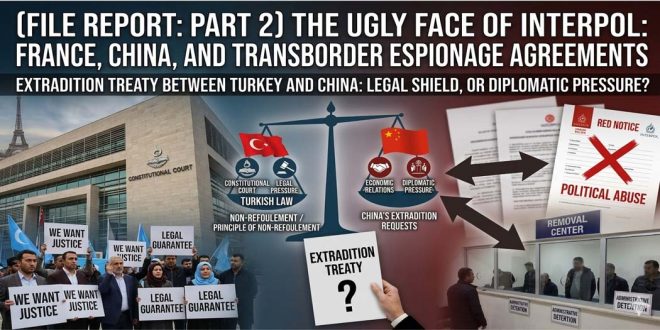
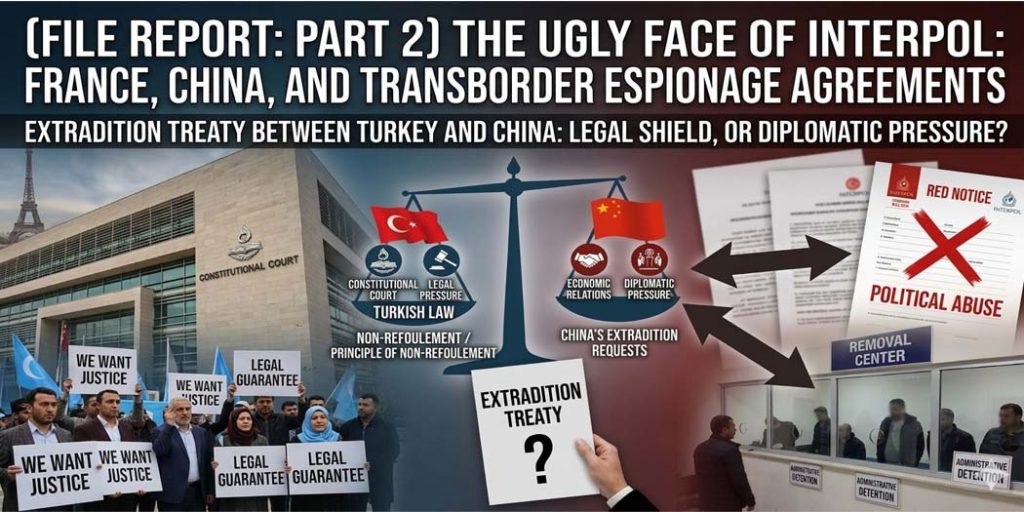
“Beijing’s global ‘red notice’ hunt, conducted through Interpol, represents a direct legal test for countries like Turkey, which hosts the largest Uyghur diaspora. Although the ‘Extradition Agreement’ signed with China appears to be an inter-state obligation, Turkey’s commitments arising from international law serve as a ‘humanitarian shield’ at this point.”
Legal Safeguard: In Turkey, extradition processes are not merely political decisions but are judicial procedures. The Turkish Penal Code and the precedents of the Constitutional Court stipulate that extradition must be halted if there is a risk that “the individual will face torture or the death penalty in the country to which they are being extradited” (non-refoulement).
1- Since Turkey is a party to the European Convention on Human Rights (ECHR), the “Prohibition of Return” (Non-refoulement) is an absolute rule.
The Concept of “Political Crime” and Protection The legal system in Turkey functions as a “last fortress” against such political requests; however, bureaucratic pressures continue to persist, and many punitive measures are carried out through these pressures.
Even in the text of the agreement between Turkey and China (as in most extradition treaties), it is stated that “crimes of a political nature” are excluded from the scope of extradition.
The Point of Conflict: China codes the activities of Uyghur activists as “terrorism” or “separatism.” The Turkish judiciary, on the other hand, is obligated to investigate whether these allegations are based on concrete evidence or if the individual is being targeted simply because of their political views or identity. If the court concludes that there is a political motive (reason) behind the extradition request, the request is rejected.
2- Constitutional Court (AYM) and ECHR Criteria
“The pressures exerted through family members, which we discussed in the first part, can turn into a psychological grip on individuals waiting in Removal Centers (GGM) in Turkey. Even if the individual is not de facto extradited, the uncertain periods spent in GGMs and the restricted social rights become part of Beijing’s ‘indirect intimidation’ strategy.”
Since Turkey is a party to the European Convention on Human Rights (ECHR), the “Prohibition of Return” (Non-refoulement) is an absolute rule.
Injunction Decisions: When an extradition process begins, if the individual proves that they will face torture or ill-treatment if sent to China (for which international human rights reports provide strong evidence), the Constitutional Court (AYM) can intervene and issue a “stay of execution” decision.
Past Examples: There are many precedent-setting decisions in Turkey where extradition orders previously issued for some Uyghur Turks were halted by the AYM on the grounds of “risk of violation of the right to life.”
3- “Administrative Detention” and Gray Areas
The biggest issue here is generally not direct extradition, but rather the processes carried out through Removal Centers (GGM).
The Process: Individuals who have an extradition request against them or who experience issues regarding their residence permits can be held in GGMs. This situation causes individuals to be deprived of their liberty for years, even if they are not ultimately extradited.
Bureaucratic Pressure: Instead of having an individual extradited, China sometimes exerts indirect pressure by making that person’s life in Turkey difficult through legal and administrative obstacles (such as freezing bank accounts, canceling work permits, etc.).
“The G-87 Grip: Where Law Ends and Bureaucracy Begins” — An Invisible Prison
The biggest obstacle for the Uyghur diaspora in Turkey in recent years is the G-87 restriction code, issued under the pretext of “General Security.”
- Citizenship Barrier: Many Uyghur Turks are deprived of their citizenship rights because of this code, despite fulfilling all necessary legal requirements.
- Freedom of Movement: The G-87 code does not only restrict an individual’s rights within Turkey; it also makes traveling abroad virtually impossible, trapping them in a “cycle of uncertainty.”
A Concrete Example That Wounds the Conscience: A Blind Elderly Uyghur
The incident you mentioned is tragic evidence of how China’s transnational repression has infiltrated bureaucratic mechanisms in Turkey.
Humanitarian Dimension: The classification of a visually impaired individual who is in need of care as a “general security threat” (G-87) raises serious questions in the public eye, suggesting that these decisions are based on external pressures rather than concrete evidence.
GGM Contradiction: Taking someone in this condition into a Removal Center proves how the “administrative detention” process discussed in your report has turned into a method of punishment.
In summary, we can discuss the following:
While the legal system (the courts) generally tends to protect these individuals, diplomatic relations and economic agreements between states can slow down or complicate this judicial process.
Do you think this legal “shield” carries the risk of being pierced as economic dependencies in foreign policy increase? Or is judicial independence a sufficient guarantee in this regard? Which part concerns you the most?
A- Economic Dependency and the Legal Shield: Historically, it has been observed that during periods of increased economic dependency (for example, massive infrastructure investments or loan agreements), states conduct “silent diplomacy.” However, the Uyghur issue in Turkey carries not only legal but also social and political sensitivity. This social legitimacy is the greatest obstacle making it difficult for the legal shield to be pierced.
B- The Most Concerning Part: The part that concerns us the most is the “Gray Areas” (Administrative processes) mentioned in the text. Even if the courts rule that an individual “cannot be extradited,” holding a person in a GGM for years or preventing them from accessing their bank account makes that person’s existence in Turkey “de facto impossible.” This situation creates a “pressure of regulations” that transcends the law, which is an area far more difficult to monitor and audit than a transparent trial process.
DID YOU KNOW?
According to the established precedents of the Turkish Constitutional Court; for a person to be extradited, the evidence presented is meticulously examined beyond “strong suspicion of crime” to determine whether it is a political fabrication. The accus
Doğu Türkistan Bülteni Haber Ajansı / HABER MERKEZİ
#Interpol #China #Turkey #HumanRights #ExtraditionTreaty #Uyghur #Justice #InternationalLaw #PoliticalAbuse #RuleOfLaw #TransnationalRepression #RedNotice #HumanitarianLaw #CivilLiberties #GlobalPolitics #ForeignPolicy #Diplomacy #Investigation #LegalShield #FreedomOfSpeech #IdentityRights #SocialJustice #StatePressure #MinorityRights #UnitedNations #Amnesty #HumanRightsWatch #WorldNews #Geopolitics #UyghurDiaspora
#BreakingNews #InvestigativeJournalism #InterpolAbuse #ChinaTurkeyRelations #ExtraditionLaw #AdministrativeDetention #LegalReport #PoliticalCrisis #G87Code #RemovalCenter #JudicialIndependence #HumanRightsAbuse #FileReport #Part2 #ExclusiveNews #GlobalSecurity #Espionage #DiplomaticPressure #ConstitutionalCourt #NonRefoulement #LegalRights #PolicyAnalysis #SecurityStudies #CurrentAffairs #Journalism #NewsUpdate #PressFreedom #InternationalRelations #PoliticalAnalysis #RightsWatch