 Doğu Türkistan Haberleri | Uygur Türkleri | Doğu Türkistan Bülteni Doğu Türkistan Haberleri, Analiz ve Güncel Gelişmeler

İlgili Makaleler
“Can the president of the world’s largest police organization, INTERPOL, disappear during a visit to his own country simply by sending a ‘knife emoji’? The Meng Hongwei scandal, which stretches from the headquarters in Lyon to the dark interrogation rooms of Beijing, is not merely a purge operation; it is the bloodiest proof of how international law has been transformed into a mechanism of ‘human hunting.’ In the third part of our file report, we reveal the tragic end of a once-powerful president and, under his leadership, the global traps set by INTERPOL in cooperation with Chinese intelligence against Uyghur Turks, through concrete cases and covert operations. Can a system that cannot protect its own president protect asylum seekers?”
1- Mysterious Disappearance (September 2018)
Meng Hongwei was living in Lyon, France, where INTERPOL’s headquarters is located. In September 2018, he traveled to China. Shortly after leaving Lyon, his wife Grace Meng received a highly disturbing message from her husband: only a “knife emoji.” This emoji was his way of signaling that he was in danger. From that moment on, there was no further news of him.
2- China’s Admission and Resignation
After days of silence and INTERPOL’s official request for clarification from China, the Beijing administration announced that Meng had been detained on suspicion of “violating the law” and was under investigation. Shortly afterward, INTERPOL announced that it had received a resignation letter—sent via Chinese authorities—stating that Meng had stepped down from his position. Many argued that this resignation was made under pressure.
3- Trial and Sentence (2020)
Chinese authorities accused Meng of accepting approximately 2 million dollars in bribes during his duties between 2005 and 2017 (including the period when he served as Vice Minister of Public Security in China).
Result: In January 2020, a court in China found Meng Hongwei guilty and sentenced him to 13 years and 6 months in prison, along with a fine of approximately 290,000 dollars.
Meng admitted the charges in court and stated that he would not appeal the decision.
4- His Wife’s Claims and Political Background
Meng’s wife, Grace Meng, was granted political asylum in France and continues to live there. She argues that the accusations against her husband are entirely political and that Meng was a victim of a purge within the Chinese Communist Party.
Why This Case Matters
INTERPOL’s Reputation: The disappearance of the president of the world’s largest police organization during a visit to his own country, followed by his detention, sparked major debate about the independence of international institutions.
The case was widely interpreted as a demonstration of how China maintains absolute control over its own officials—even those holding senior positions in international organizations—regardless of their status.
As of now, Meng Hongwei continues to serve his prison sentence in China and has no contact with the outside world.
“The Meng Hongwei case is, in fact, a shocking message delivered to the international public: if China’s ‘long arm’ can reach even the highest level of the world’s largest police organization, then no geography and no refugee is ever completely safe. In a system where INTERPOL itself could not protect its own president from Beijing’s dark corridors, the files of asylum seekers, activists, and families are not merely documents, but matters of life and death. Meng ultimately falling into the very trap he once helped create is a historical lesson showing that where justice becomes politicized, even the executioner is not safe. This file is not only a record of the past; it is one of the most urgent warnings of today about how law is transformed into a weapon through cross-border operations.”
“Uyghur Turks handed over by China through INTERPOL between 2005 and 2017 under Meng’s leadership”
he period from 2005 to 2017, which includes Meng Hongwei’s tenure and also his earlier period as Vice Minister of Public Security of China, was one of the most intensive phases in which China used INTERPOL through the “Red Notice” system. During this period, many Uyghur Turks were targeted on charges of “terrorism” or “separatism” due to their political activities, and some were extradited.
Meng Hongwei’s influence within INTERPOL and the key cases that stood out during that period are as follows:
1- Huseyin Celil Case (2006)
This is one of the most well-known cases of the period and one that led to an international crisis.
Incident: Uyghur activist Huseyin Celil, a Canadian citizen, was arrested in 2006 while visiting his family in Uzbekistan, following China’s request and pressure carried out through INTERPOL channels.
Outcome: Despite Canada’s objections, he was extradited by Uzbekistan to China. He was sentenced to life imprisonment in China. His Canadian citizenship was not recognized by China, and there was no long-term information about his condition.
2- Ismail Semed Case (2007)
Incident: Ismail Semed was a Uyghur Turk who had sought refuge in Pakistan. As a result of China’s “separatism” allegations and the use of INTERPOL channels, he was extradited from Pakistan to China.
Outcome: In February 2007, he was executed in Urumqi. This case is recorded as one of the most tragic examples of asylum seekers being extradited through INTERPOL channels and subsequently executed.
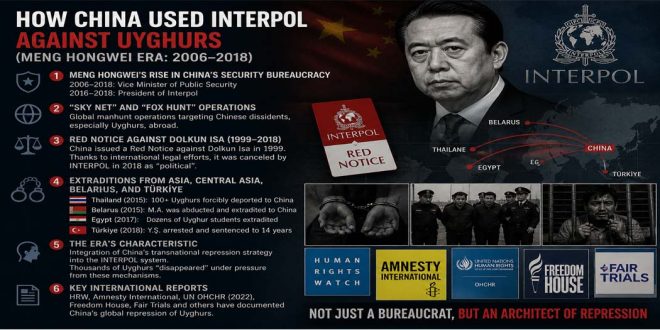
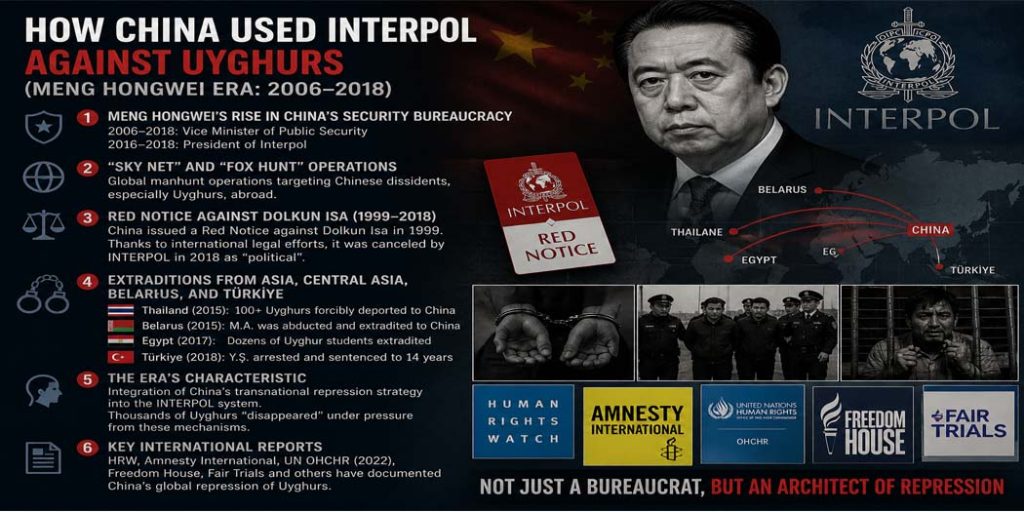
3- Red Notice Against Dolkun Isa (1999–2018)
Dolkun Isa, President of the World Uyghur Congress, was one of China’s primary targets during both Meng Hongwei’s earlier roles in China and his later tenure as INTERPOL President.
Process: China issued a Red Notice against Dolkun Isa in 1999. Due to this notice, Isa was repeatedly detained or faced restrictions in countries such as South Korea, Italy, Türkiye, and the United States.
Meng’s Role: When Meng Hongwei was elected INTERPOL President in 2016, human rights organizations expressed concern that this notice could be enforced more aggressively. However, following sustained efforts by international legal organizations (such as Fair Trials), the Red Notice was ultimately cancelled by INTERPOL in 2018—shortly before Meng’s removal from office—on the grounds that it was politically motivated.
4- Southeast Asia, Central Asia, Belarus and Türkiye
During this 12-year period when Meng held a top position in China’s security bureaucracy, hundreds of Uyghurs were extradited through China’s influence over neighboring countries:
Thailand (2015): More than 100 Uyghur Turks were forcibly sent from Thailand to China as a result of China’s terrorism allegations and diplomatic pressure. This incident triggered worldwide protests.
Belarus (2015): M.A., Deputy Chairman of the Turkistan Islamic Association, was detained due to INTERPOL France and China cooperation. Because no notification was provided while he was in Türkiye for travel, no INTERPOL alert had been issued. He was later arrested by INTERPOL at the Belarus airport while traveling for business and handed over to China. He reportedly suffered various forms of torture and, wearing 40-kilogram shackles on his feet, completed a 3.5-year sentence and later returned to his homeland, Türkiye.
Egypt (2017): In July of the year Meng became INTERPOL President, dozens of Uyghur students studying at Al-Azhar University in Egypt were detained in a joint operation by Chinese intelligence and Egyptian police and extradited to China.
Türkiye (2018): Y.Ş., President of the Turkistan Islamic Association, was involved in a case during Meng’s tenure in which, through INTERPOL–France–China cooperation, he came to give an interview to a French journalist. After the interview, he allegedly acted as a so-called “confessor” and met with the French Consulate, then went to the Esenler Bus Terminal Police Station with the consulate to file a complaint. After spending 15 months in prison, in 2026 he was sentenced to 14 years in this case. He is still in Türkiye today.
Characteristics of the Meng Hongwei Era
Meng’s brief presidency between 2016 and 2018, as well as his long prior period as Vice Minister of Public Security, marked a phase in which China’s strategies such as “Sky Net” and “Fox Hunt” to hunt down dissidents abroad were increasingly integrated into the INTERPOL system.
Important Note: It is also claimed that one of the reasons Meng Hongwei himself was “removed” by China in 2018 was his inability to prevent the cancellation of certain Red Notices within INTERPOL (as in the Dolkun Isa case) and his relatively strong alignment with Western legal norms.
During this period, the exact number of extraditions remains unknown due to China’s non-transparent judicial system. However, human rights organizations state that thousands of Uyghurs “disappeared” under pressure from these mechanisms.
Key International Reports
1. Human Rights Watch – Reports state that China targets the Uyghur diaspora on a global scale under the justification of counterterrorism.
It has published numerous reports on China’s policies toward Uyghurs.
In particular:
- Arbitrary detentions
- The political use of “terrorism” charges
- Pressure and intimidation against Uyghurs abroad
2. According to Amnesty International – China leaves Uyghurs abroad exposed to pressure and the risk of extradition.
Works such as the “Longest Nights” (and related report series) include testimonies describing:
- Torture
- Enforced disappearances
- Transnational repression
3. United Nations – OHCHR Report (2022)
In United Nations reports, it is stated that China’s practices may amount to crimes against humanity.
The report of the UN Office of the High Commissioner for Human Rights (OHCHR) contains a critical finding:
“Violations that may amount to crimes against humanity.”
4. According to Freedom House data, China ranks first among countries engaging in transnational repression.
“Transnational Repression” reports identify China as the most active state in this field.
5. Fair Trials reports reveal that INTERPOL’s Red Notice system has been misused by some states for political purposes.
Special studies on INTERPOL abuse focus on the issue of “politically motivated use of Red Notices.”
East Turkistan Bulletin News Agency / News Center
#INTERPOL #MengHongwei #ChinaEspionage #UyghurRights #EastTurkistan #HumanRights #InternationalLaw #InterpolScandal #RedNotice #PoliticalPersecution #ChinaHumanRights #UyghurGenocide #CrossBorderRepression #GlobalSecurity #RuleOfLaw #HumanRightsAbuse #ForcedExtradition #AsylumSeekers #RefugeeRights #FairTrials #JusticeSystem #StateRepression #ChinaPolitics #UyghurCrisis #Disappearances #SecretDetention #BeijingControl #InterpolAbuse #InternationalJustice #HumanRightsWatch
#INTERPOL #MengHongwei #InterpolScandal #ChinaEspionageNetwork #UyghurRights #EastTurkistanNews #HumanRightsReport #InternationalLawCrisis #RedNoticeSystem #PoliticalPersecutionChina #ChinaHumanRightsAbuse #UyghurCrisisReport #UyghurGenocideAllegations #CrossBorderRepressionChina #GlobalSecurityAlert #RuleOfLawViolation #HumanRightsAbuseCases #ForcedExtraditionCases #AsylumSeekersRights #RefugeeProtection #FairTrialsMovement #JusticeSystemCrisis #StateRepressionChina #ChinaPoliticsNews #DisappearancesCase #SecretDetentionChina #BeijingControlSystem #InterpolAbuseCase #InternationalJusticeSystem #HumanRightsInvestigation