 Doğu Türkistan Haberleri | Uygur Türkleri | Doğu Türkistan Bülteni Doğu Türkistan Haberleri, Analiz ve Güncel Gelişmeler

İlgili Makaleler



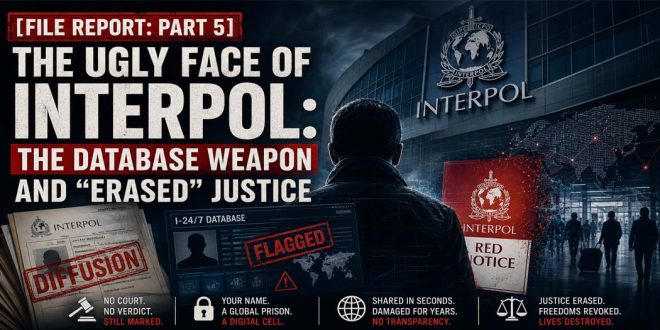
It only took a few seconds for your name to be entered into a database. But did you know that you don’t necessarily need a court ruling to be labeled as a “wanted criminal” at border crossings around the world?
Today, a digital signal issued from INTERPOL’s headquarters in Lyon can bypass legal systems and turn your life into a prison-like existence. In the fifth part of our investigative series, we expose the hidden weapon behind authoritarian regimes and intelligence agencies operating under the shadow of the “Red Notice”: the dark reality of “Diffusion.”
Welcome to that grey zone where justice is erased and digital executions begin—because here, it is not the presumption of innocence that prevails, but the ruthless speed of a database.
1 – Digital Execution – “Being Convicted Without Being Declared Guilty”
The INTERPOL system eliminates the presumption of innocence within a digital labyrinth. A data entry originating from member states, once it enters the system without being properly filtered at the organization’s headquarters in Lyon, effectively constructs a “global prison” for the individual concerned.
Systematic Labeling: Individuals who have not yet been found guilty by an independent court can, the moment they are entered into the INTERPOL database (I-24/7), face a range of unofficial sanctions—from frozen bank accounts to travel restrictions.
Legal Vacuum: “Intelligence notes” prepared by security agencies can be injected into the system without concrete evidence, yet still carry labels such as “terrorism” or “organized crime.” This creates a mechanism through which legal safeguards are bypassed in favor of political agendas.
2 – File Analysis – Invisible Weapon: “Diffusion” Messages
While many people are only familiar with the Red Notice, the real risk lies in a far more flexible and difficult-to-control mechanism known as “Diffusion.”
Unregulated Speed: Unlike Red Notices, which undergo a certain level of preliminary review by the INTERPOL General Secretariat before publication, Diffusion messages can be shared directly between member states. This enables authoritarian regimes to detain individuals at border points through “instant” operations against dissidents.
Intelligence–Judiciary Conflict: Cases where local courts have acquitted individuals by ruling that there is “no criminal element,” or have rejected extradition requests, may still remain active within the INTERPOL system through intelligence reports. The continued validity of such files despite judicial decisions severely undermines international legal security by weakening court rulings in the face of intelligence notes.
Reports by international human rights organizations have also raised similar concerns regarding the INTERPOL system. Studies published by Fair Trials highlight that mechanisms such as “Red Notices” and “Diffusions” can be subject to misuse by certain states for political purposes, and that the lack of sufficient oversight mechanisms may place individuals’ fundamental rights at risk.
Similarly, assessments by Human Rights Watch note that some requests entered into the INTERPOL system may conflict with the principles of fair trial, and can result in restrictions on international freedom of movement—particularly affecting dissidents, activists, and individuals in exile. These reports do not claim that the system is entirely dysfunctional; rather, they emphasize the need to strengthen its structure in terms of transparency, accountability, and human rights standards.
3 – CCF – The Slow Wheels of Justice
The Commission for the Control of INTERPOL’s Files (CCF) is tasked with correcting errors within the system, yet in practice, its processes often work against individuals rather than in their favor.
Years-Long Appeal Procedures: The removal of an unlawful entry from the system typically takes between 9 months and 3 years. During this period, individuals may experience the collapse of their professional lives, the breakdown of family unity, and a form of existence best described as “digital exile.”
Transparency Issues: CCF decisions are generally kept confidential, while political pressure from member states looms over the commission like a modern “Sword of Damocles.”
The most concrete reflections of these structural problems are seen in long-standing cases of human rights concerns. For instance, Bill Browder was repeatedly targeted for inclusion in the INTERPOL system at Russia’s request. Although most of these requests were rejected on political grounds, the process still significantly affected his international travel and left him in a state of ongoing legal uncertainty.
Similarly, against Kazakh dissident and businessman Mukhtar Ablyazov, issued notices and diffusion requests triggered prolonged detention and extradition proceedings in various countries. Even though multiple courts ruled these requests to be politically motivated, the continued presence of the files within the system has drawn significant criticism.
These examples illustrate how an entry in the INTERPOL database can evolve into a de facto punishment lasting for years—even when its legal basis has been challenged or discredited—and how the CCF mechanism often fails to provide timely remedies for the harm caused.
So the fundamental question remains: Can a data entry outweigh a human life?
Without any court ruling against you, could you be stopped at borders, have your bank accounts suspended, and be forced into a prolonged identity of “digital suspect” based solely on a system entry? If the answer is “yes,” then what we are facing is not merely a technical issue, but a global and invisible crisis of justice. And perhaps this “silent execution” experienced by others today is far closer to each of us than we think.
INTERPOL file analysis, Red Notice search, Diffusion notice meaning, international law scandals, CCF appeal process, digital execution concept, political extradition requests, INTERPOL database system, intelligence reports misuse, human rights violations, Red Notice cancellation, investigative journalism report
East Turkestan Bulletin News Agency / News Desk
#Interpol #DataPrivacy #HumanRights #UyghurRights #EastTurkestan #SurveillanceState #GlobalJustice #RuleOfLaw #HumanRightsAbuse #DataMisuse #InternationalLaw #CriminalJustice #RedNotice #PoliticalPersecution #FreedomOfSpeech #CivilLiberties #DigitalSurveillance #PrivacyRights #StatePower #Accountability #JusticeSystem #GlobalSecurity #RightsViolation #EthnicMinorities #DueProcess #LawEnforcement #HumanRightsWatch #UNHumanRights #JusticeForAll #PressFreedom
#BreakingNews #InvestigativeJournalism #NewsReport #GlobalNews #WorldNews #PressFreedom #NewsMedia #DocumentaryNews #FactChecking #NewsUpdate #PoliticalNews #InternationalNews #HumanRightsNews #JusticeNews #LegalNews #SecurityNews #CyberSecurity #DataPrivacy #DataRights #SurveillanceNews #GovernmentAccountability #Transparency #PublicInterest #NewsCoverage #Reportage #NewsAnalysis #WatchdogJournalism #CurrentAffairs #GlobalIssues #HumanRightsReport